Renewables Met All New Electricity Demand in 2025: A Turning Point for the Global Energy Transition
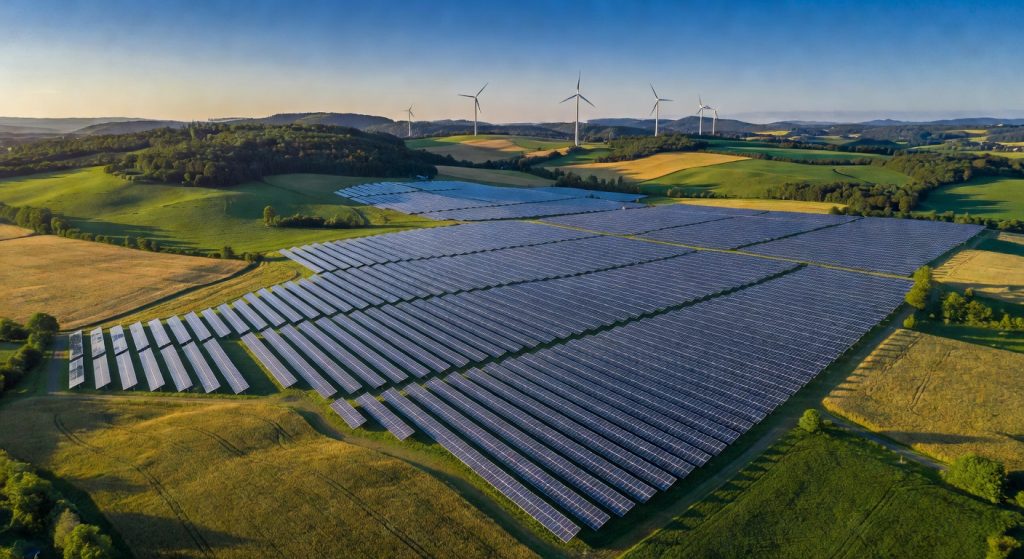
For the first time in the modern energy era, renewable energy sources met 100% of all new global electricity demand in 2025. According to a landmark report by Ember, the independent international energy research organisation, solar and wind power expanded fast enough to absorb every additional unit of electricity consumption worldwide — while fossil fuel generation remained essentially flat. It is a milestone that energy analysts have long anticipated, and its arrival carries profound implications for policy, investment, and the pace of the global energy transition.
Solar Leads a Historic Shift in the Global Energy Mix
Of all the forces driving this transformation, solar energy stands out as the defining story of 2025. Ember’s data confirms that solar was the fastest-growing fuel source on the planet last year, outpacing wind, gas, and every other technology in terms of year-on-year output growth. Solar output is now sufficient to meet the electricity needs of entire regions — a figure that would have seemed extraordinary just a decade ago.
The engine behind this acceleration is largely Asian. China and India are now the undisputed leaders in solar production and deployment, channelling enormous capital into photovoltaic manufacturing and grid-scale installations. Their investment is driving down costs globally, making solar increasingly competitive even in markets with less favourable financing conditions — including many parts of Europe.
In the United States, the picture is similarly encouraging. Wind and solar together generated 760,000 gigawatt-hours (GWh) of electricity in 2025, up 88,000 GWh compared to 2024, and now representing 17% of total U.S. electricity generation. One of the most striking local examples comes from Puerto Rico, where rooftop solar became the island’s second-largest generating capacity source at 1,456 megawatts — surpassing natural gas and accounting for 81% of all new generating capacity added between 2016 and 2025. It is a powerful demonstration of what distributed, community-level resource management can achieve even in challenging grid environments.
Decoupling Growth from Fossil Fuels — and What It Means for Europe
The concept of decoupling — growing electricity supply without growing fossil fuel consumption — has moved from theoretical aspiration to measurable reality. U.S. coal exports declined by 16 million short tons in 2025 compared to 2024, with thermal coal exports falling 18% and metallurgical coal exports dropping 11%, reflecting a structural reduction in global coal demand rather than a temporary fluctuation.
For Europe, these trends arrive at a critical moment. The continent is simultaneously navigating energy security concerns, industrial competitiveness pressures, and binding climate targets under the European Green Deal. The good news is that Europe remains a global leader in wind energy, offshore in particular, and is rapidly scaling onshore solar across southern and central regions. The challenge lies in translating generation capacity into system-wide energy efficiency — ensuring that grids, storage solutions, and demand-side management keep pace with supply growth.
Emerging technologies are also entering the equation. Green hydrogen, produced via electrolysis powered by surplus renewable electricity, is increasingly seen as a strategic tool for decarbonising hard-to-abate industrial sectors and for seasonal energy storage. The EU’s hydrogen strategy envisions 10 million tonnes of domestic production by 2030, a target that now looks more credible given the pace of renewable expansion. Alongside hydrogen, smarter water management — including the cooling needs of data centres and the hydropower potential of river systems — will be essential to a resilient, low-carbon energy architecture.
Implications: From Milestone to Momentum
Reaching the point where renewables cover all new demand is significant, but it is not the finish line. The next challenge is displacing existing fossil fuel generation, not merely containing its growth. That requires:
- Accelerated grid modernisation and cross-border interconnection, especially within the EU’s internal energy market
- Robust investment in battery storage and demand flexibility to manage solar and wind variability
- Policy frameworks that reward energy efficiency alongside generation capacity
- Fair transition support for communities and workers dependent on coal and gas industries
Key takeaway: The 2025 data from Ember marks a genuine inflection point in the global energy transition. Renewable energy — led by an extraordinary surge in solar — has proven it can grow faster than demand itself. For Europe, the task now is to convert this global momentum into structural change at home: smarter grids, greener industry, and an energy system built for the long term.