Record $2.3 Trillion in Clean Energy Investment: How Green Tech Is Reshaping the Global Economy
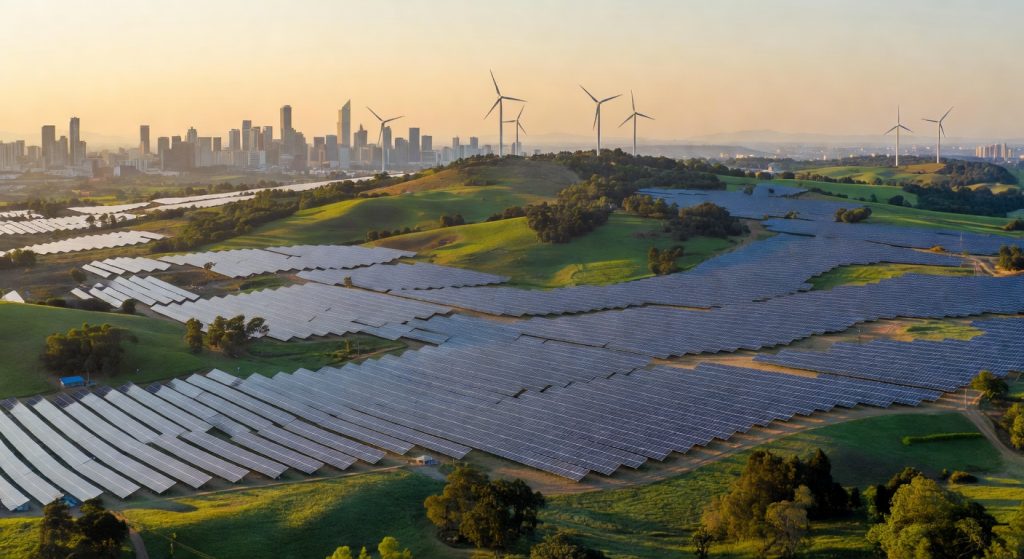
The numbers are in, and they are striking. Global investment in the energy transition reached a record $2.3 trillion in 2025, an 8% increase over 2024, spanning renewables, nuclear power, electrified transport, green hydrogen, and carbon capture technologies. At the same time, a U.S. federal court delivered a significant legal victory for clean energy developers, temporarily blocking a series of Trump administration measures designed to obstruct renewable energy projects. Taken together, these developments paint a picture of an energy transition that is accelerating — even when politics tries to slow it down.
A Record Year for Clean Energy Investment
The $2.3 trillion milestone, tracked across global markets, signals that green technology and cleantech are no longer niche sectors — they are the backbone of a new industrial economy. According to the World Economic Forum’s 2025 Energy Transition Index, clean energy investment already exceeded $2 trillion in 2024, with 65% of countries improving their energy transition performance year-on-year.
The geography of this investment is telling. Advanced economies — including European Union member states — are prioritising grid modernisation and storage infrastructure to accommodate growing shares of variable renewables. Meanwhile, emerging economies in Asia are leapfrogging legacy systems through distributed solar and digital energy management. Sub-Saharan Africa, often overlooked in these conversations, is making meaningful regulatory progress that could unlock significant private capital in the years ahead.
For Europe, this global momentum reinforces the strategic logic of the Green Deal and REPowerEU. The continent’s push to reduce dependence on fossil fuel imports while building domestic green innovation capacity is increasingly aligned with where global capital is flowing. The competitive pressure is real: if Europe does not move fast enough, leadership in key cleantech sectors — from offshore wind to green hydrogen — risks shifting elsewhere.
Courts, Policy, and the Fight for Renewable Projects
Not all progress is smooth. In the United States, the Trump administration has pursued a series of executive and regulatory actions aimed at slowing or reversing clean energy development. A U.S. District Court judge in Boston has now temporarily halted several of these measures, ruling in favour of renewable energy developers in what CleanTechnica describes as a key win for the sector.
This legal battle carries lessons that resonate well beyond American borders. Across Europe and globally, the energy transition is not only a technological or financial challenge — it is also a governance and legal one. Regulatory stability, long-term policy frameworks, and independent judicial oversight are critical enablers of green innovation. When those foundations are solid, investment follows. When they are undermined, projects stall and capital retreats.
The European model — with binding renewable energy targets, carbon pricing through the EU ETS, and increasingly robust permitting reform — offers a degree of policy certainty that many investors find attractive precisely because it is harder to dismantle overnight. The U.S. court ruling is a reminder of why institutional resilience matters.
Electric Mobility and Corporate Green Procurement: Building the Infrastructure
Two further developments illustrate how the energy transition is moving from macro-finance into everyday infrastructure. In San Diego, the city announced the installation of 67 public EV chargers at recreation centres, part of a broader plan to deploy 750–800 chargers across the metropolitan area. It is a modest but meaningful step toward making electric mobility genuinely accessible to all citizens — not just those who can afford home charging.
On the corporate side, Google signed a 30 MW solar power purchase agreement in Malaysia under the country’s Corporate Green Power Programme — its first utility-scale renewable deal in the country. This kind of corporate renewable procurement is increasingly shaping energy markets in emerging economies, driving demand that supports new project development and green innovation at scale.
- $2.3 trillion invested globally in the energy transition in 2025 (+8% vs 2024)
- 65% of countries improved energy transition performance in 2024 (WEF)
- 67 new public EV chargers deployed in San Diego, with 750–800 planned
- 30 MW solar PPA signed by Google in Malaysia — a first for the market
What This Means for Europe and the Road Ahead
For European citizens, professionals, and policymakers, the takeaway is clear: the global energy transition is not waiting. Record investment figures, expanding EV infrastructure, and growing corporate demand for clean power are reshaping industries and labour markets at speed. Europe’s ability to remain competitive in this landscape depends on maintaining policy ambition, accelerating grid investment, and supporting the green technology innovators — large and small — that will define the next decade.
The key takeaway: $2.3 trillion in a single year is not just a statistic. It is a signal that the clean energy economy has reached a scale where momentum is self-reinforcing. Courts, companies, and cities are all moving in the same direction. The question for Europe is not whether to participate — but whether to lead.