Green Tech in 2025: Electric Motorcycles, Circular Cities, and the €2 Trillion Energy Transition
The pace of green innovation rarely slows, but some weeks feel like a turning point. This is one of them. From a century-old motorcycle brand going electric to European researchers turning urban waste into household products, the signals are clear: the energy transition is no longer a distant ambition — it is an industrial reality unfolding across continents, sectors, and supply chains.
Royal Enfield’s Electric Debut: A Symbol Bigger Than a Motorcycle
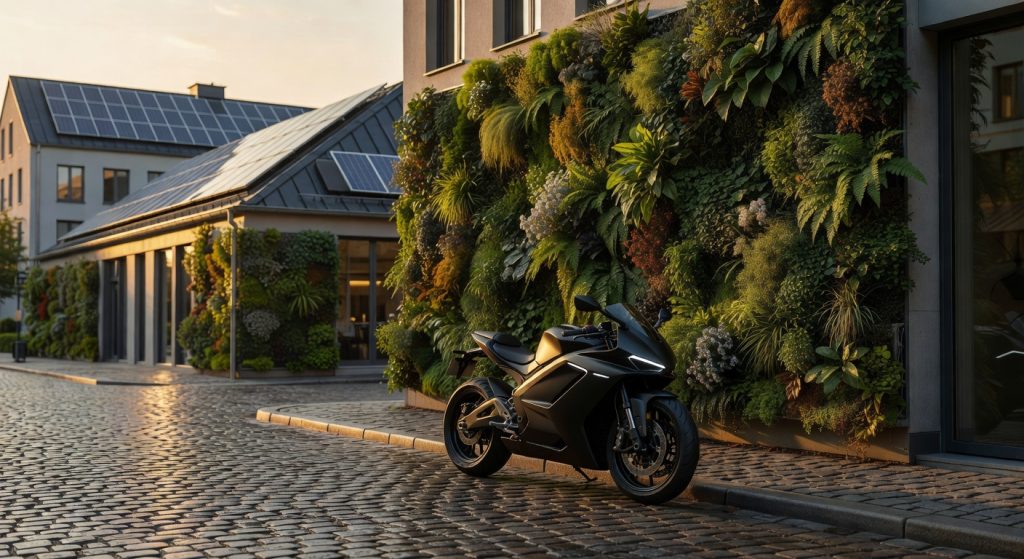
When Royal Enfield — the world’s oldest continuous motorcycle manufacturer — unveiled its first electric model, the Flying Flea C6, the move carried symbolic weight far beyond the product itself. Founded in 1901, the brand has been synonymous with internal combustion engines for over a century. Its pivot to electric mobility marks a cultural and commercial milestone for the global two-wheeler market, which serves hundreds of millions of urban commuters, particularly across Asia and Southern Europe.
For European cities grappling with air quality targets and urban congestion, the electrification of motorcycles and scooters represents a critical — and often underestimated — piece of the smart cities puzzle. Two-wheelers are among the most common forms of urban transport in cities like Rome, Barcelona, and Athens. Their electrification, now accelerated by legacy brands entering the space, could meaningfully reduce street-level emissions where they matter most: in dense, populated neighbourhoods.
Europe’s Circular Economy Edge: From Waste to Product
Meanwhile, EU researchers have achieved a breakthrough that exemplifies the kind of system-level thinking driving the next wave of green technology. Scientists have developed a process to convert urban waste carbon emissions into everyday household products — including cleaning liquids and synthetic leather — closing the loop between industrial pollution and consumer goods.
This is circular economy innovation at its most tangible. Rather than simply capturing or storing carbon, the process transforms it into marketable goods, creating economic value while reducing city greenhouse gas emissions. For European municipalities under pressure to meet climate targets, this kind of solution offers a dual dividend: environmental impact and local manufacturing opportunity.
It aligns with a broader trend identified across the cleantech sector: the shift from isolated technological fixes toward integrated, system-level green solutions. Sweden’s H2 Green Steel facility, set to launch in 2026, is another example — embedding green hydrogen directly into industrial production rather than treating it as a standalone experiment.
The Global Energy Transition: €2 Trillion and 16 Million Jobs
The World Economic Forum’s 2025 Energy Transition Index puts the macro picture into sharp relief. Global clean energy investment has now reached $2 trillion annually, clean electricity accounts for 49% of global generation, and the sector supports 16 million jobs worldwide. China and Japan lead on innovation metrics, but Europe remains a regulatory and policy anchor for the transition.
On the hydrogen front, two developments deserve attention. A new proposal for modular e-fuels facilities in Europe aims to produce sustainable military fuels using green hydrogen, addressing energy security concerns alongside decarbonisation goals. Across the Atlantic, California’s Avina Clean Hydrogen Facility — producing 4 metric tons of hydrogen daily and projected to cut 130,000 tonnes of CO₂ per year — is advancing despite federal headwinds, powered by state-level support. It is a reminder that cleantech resilience increasingly depends on regional and local governance, not just national policy.
Emerging technologies are also reshaping the energy landscape from the ground up:
- Solid-state batteries are approaching commercial viability, promising safer, longer-range electric vehicles.
- AI and IoT are being deployed to optimise energy grids and building consumption in real time.
- Vehicle-to-home (V2H) technology is enabling EV owners to power their households from their car battery, reducing energy costs and grid pressure simultaneously.
What This Means for Europe’s Green Agenda
Taken together, these developments paint a picture of an energy transition that is accelerating, diversifying, and — crucially — becoming economically self-sustaining. For European citizens, professionals, and policymakers, the implications are concrete:
- Urban mobility is being reimagined from the ground up, with electric two-wheelers joining EVs as mainstream options.
- Industrial decarbonisation is generating new product categories and manufacturing jobs, not just costs.
- Energy security and climate goals are increasingly converging, particularly around green hydrogen and local production.
The key takeaway: green innovation in 2025 is no longer about isolated breakthroughs — it is about integration. The technologies, policies, and business models are beginning to reinforce one another. For Europe, which has long led on regulation and ambition, the challenge now is to match that leadership with speed of implementation.