Europe’s Renewable Energy Push in 2026: Solar, Wind, and Hydrogen Lead the Transition
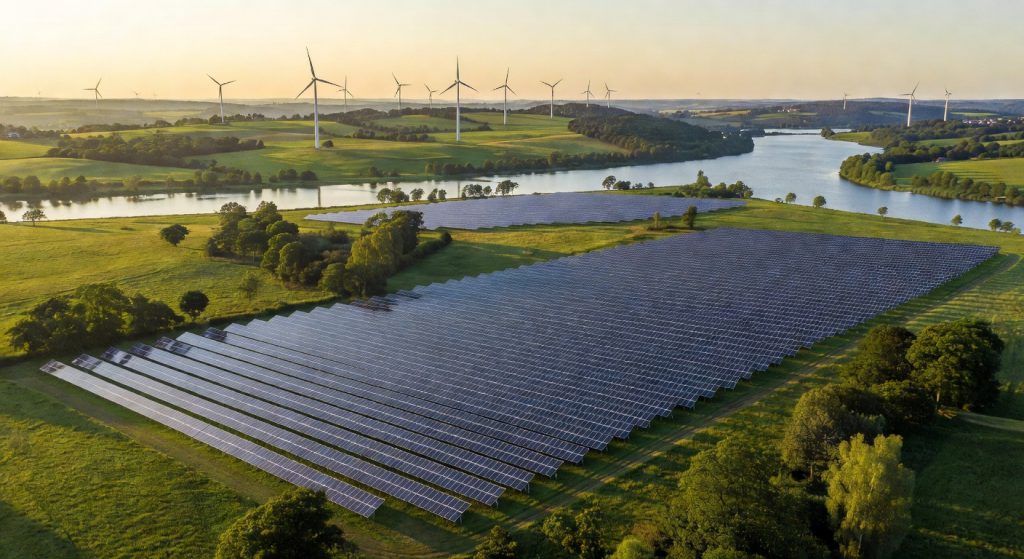
Europe’s energy landscape is undergoing a profound transformation. As the continent races to meet its 2030 climate targets, the latest data from early 2026 paints an increasingly confident picture: renewable energy is no longer an alternative — it is the backbone of a new industrial and environmental strategy. From the sun-drenched plains of southern Spain to the wind-swept coasts of the North Sea, the pieces of a cleaner energy future are rapidly falling into place.
Solar and Wind Break Records Across the Continent
The European Union closed 2025 with a landmark achievement: for the first time, solar and wind energy together accounted for more than 30% of total electricity generation across member states, according to data from Ember Climate. Solar capacity additions alone surpassed 65 gigawatts in a single year, driven by aggressive national incentive programmes in Germany, Italy, Spain, and the Netherlands.
Wind power, both onshore and offshore, continues its upward trajectory. The North Sea is fast becoming one of the world’s most productive energy zones, with the UK, Denmark, Germany, and Belgium investing billions in next-generation offshore wind farms. The EU’s Wind Power Action Plan, launched in late 2023, has helped cut permitting timelines significantly — a bottleneck that had long frustrated developers.
- Solar PV: Over 320 GW of cumulative installed capacity in the EU by end of 2025 (SolarPower Europe estimate)
- Offshore wind: More than 35 GW installed in European waters, with 111 GW targeted by 2030
- Energy efficiency improvements in buildings and industry saved an estimated 150 TWh across the EU in 2025
Green Hydrogen: Scaling Up, But Challenges Remain
Perhaps no technology better captures both the ambition and the complexity of Europe’s energy transition than green hydrogen. Produced by splitting water molecules using renewable electricity, green hydrogen promises to decarbonise heavy industry, long-distance transport, and seasonal energy storage — sectors where electrification alone falls short.
The EU’s REPowerEU plan targets 10 million tonnes of domestically produced green hydrogen by 2030. Progress has been real but uneven. Electrolyser manufacturing is scaling up, with European companies like Nel Hydrogen and ITM Power expanding production capacity. Spain and Portugal are positioning themselves as future hydrogen exporters, leveraging their exceptional solar resources and Atlantic winds.
Yet the economics remain challenging. The cost of green hydrogen production — still roughly €4–6 per kilogram in most European contexts — needs to fall significantly to compete with fossil-fuel alternatives. Water resource management also presents a critical constraint: electrolysis is water-intensive, and in drought-prone southern Europe, large-scale hydrogen production must be carefully planned to avoid straining already stressed freshwater systems. Innovative solutions, including the use of desalinated seawater, are being piloted along Mediterranean coastlines.
Resource Management and the Water-Energy Nexus
The clean energy transition is inseparable from smarter resource management. Water, in particular, sits at the heart of multiple energy systems — from hydropower reservoirs affected by changing precipitation patterns, to cooling water for thermal plants, to the growing demands of hydrogen production.
A 2025 report by the European Environment Agency warned that water stress could undermine energy security in parts of southern and central Europe if the sector fails to adapt. In response, several EU member states are integrating water impact assessments into their national energy plans for the first time. Technologies improving energy efficiency in water treatment and distribution — themselves significant electricity consumers — are also gaining traction as a dual-benefit solution.
What This Means for Citizens and Decision-Makers
For European citizens, the transition brings tangible benefits: lower long-term energy bills, cleaner air, and greater energy independence from volatile global fossil fuel markets. For businesses and policymakers, the message is equally clear — the window to align strategies with the clean energy economy is open, but it will not stay open indefinitely.
Investment in grid infrastructure, cross-border energy interconnectors, and digital energy management tools will be as decisive as the renewable capacity itself. The EU’s upcoming review of its Energy Efficiency Directive and the continued rollout of the Hydrogen Bank will be key milestones to watch in the months ahead.
Key takeaway: Europe’s renewable energy transition is accelerating on multiple fronts simultaneously — solar, wind, hydrogen, and efficiency. The challenge now is not whether to transition, but how to manage it wisely, ensuring that resource constraints like water scarcity and grid limitations are addressed as seriously as the gigawatt targets themselves.