USDA Reshapes Food Processing and Clean Energy Policy: What It Means for Global Food Systems
The United States Department of Agriculture (USDA) has rolled out a cluster of significant policy moves in recent weeks — from deregulating poultry and pork processing line speeds to injecting $180 million into biofuels and clean energy infrastructure. While these decisions are rooted in domestic priorities, their ripple effects on global food systems, supply chain sustainability, and the broader transition toward sustainable agriculture deserve close attention — especially from a European perspective.
Faster Lines, Lower Costs — But at What Price?
The headline move is the USDA’s proposal to remove what it calls “outdated bottlenecks” in poultry and pork processing plants, allowing modern facilities to operate at higher line speeds. Secretary Brooke Rollins framed the change as a tool for efficiency: lower production costs, more stable food supply chains, and reduced grocery bills for American consumers.
On the surface, this is a supply chain story. But it raises deeper questions about the trade-offs between industrial food efficiency and the principles of agroecology — a model that prioritises ecological balance, worker welfare, and long-term resilience over throughput maximisation. Critics of high-speed processing lines have long pointed to increased risks for slaughterhouse workers and reduced capacity for quality oversight. In the EU, where the Farm to Fork Strategy explicitly links food system reform to social and environmental sustainability, such a deregulatory approach would face significant political resistance.
For European policymakers and agribusiness leaders, this divergence matters. If US producers can lower costs through deregulation while EU competitors must meet stricter standards, the competitive dynamics of international trade — particularly in meat and processed foods — could shift. It’s a tension that will likely resurface in future transatlantic trade negotiations.
$180 Million for Biofuels and Clean Energy: A Step Toward Sustainability?
More encouraging from a sustainability standpoint is the USDA’s $180 million investment in biofuels and clean energy projects aimed at expanding sustainable infrastructure across American agriculture. This funding targets rural energy systems, farm-level renewable installations, and biofuel supply chains — areas where the US has historically lagged behind Europe’s more integrated green energy transition.
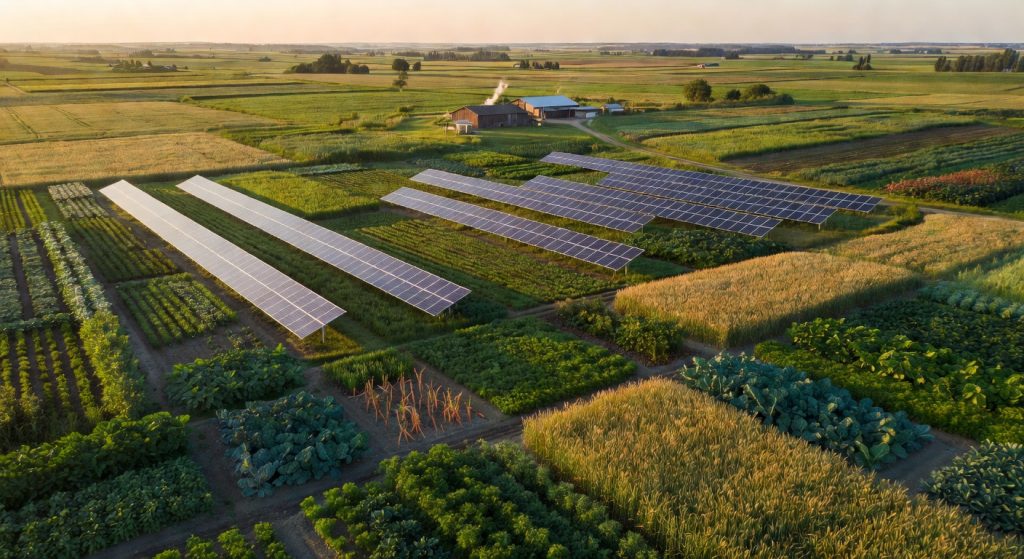
This investment aligns with a global trend: agriculture is increasingly seen not just as a food producer, but as a clean energy contributor. In Europe, agrivoltaics — the co-location of solar panels and crops — is gaining ground as a dual-use strategy. The USDA’s push into biofuels, while not without controversy regarding land use and emissions accounting, signals that American agriculture is beginning to integrate energy transition goals into its core planning.
For plant-based and alternative protein sectors, this investment in rural clean energy infrastructure could also reduce the carbon footprint of food processing facilities — a key metric for sustainability-conscious investors and consumers on both sides of the Atlantic.
Food Aid, Farmer Trust, and the Data Gap
Two other developments round out the picture. The USDA’s $263 million in food purchases — covering dairy and nuts for food banks — reflects a dual mandate: supporting producers while expanding access to healthier, more affordable food for vulnerable citizens. It’s a model that echoes EU intervention mechanisms, though the US approach remains more market-driven than structurally redistributive.
Perhaps most telling for long-term policy is the record-low farmer response rate to the USDA’s March Prospective Plantings survey. Accurate agricultural data is the backbone of supply chain sustainability planning — without it, governments and markets fly blind. The erosion of farmer trust in public institutions is not uniquely American; across Europe, protests from France to Germany have underscored a deepening disconnect between agricultural policy and the people it affects.
Implications for Europe and the Global Food Transition
Taken together, these USDA moves paint a complex picture: deregulation in processing, investment in clean energy, emergency food support, and a fraying relationship with farmers. For Europe, the lessons are instructive:
- Regulatory divergence between the EU and US on food safety and processing standards will complicate trade alignment and consumer trust.
- Clean energy investment in agriculture is becoming a geopolitical as well as environmental priority — Europe must maintain its leadership position.
- Farmer engagement is not optional: sustainable agriculture transitions fail without the active participation of producers.
Key takeaway: The USDA’s latest policy package reflects the tensions at the heart of every food system reform — efficiency versus sustainability, short-term cost reduction versus long-term resilience. As the EU advances its own Farm to Fork ambitions, watching how the world’s largest agricultural economy navigates these trade-offs offers both a cautionary tale and, in its clean energy investments, a glimpse of shared direction.