Solar Cells at 32.76% Efficiency, EV Batteries for Cities, and the EPA U-Turn: Green Tech’s Defining Week
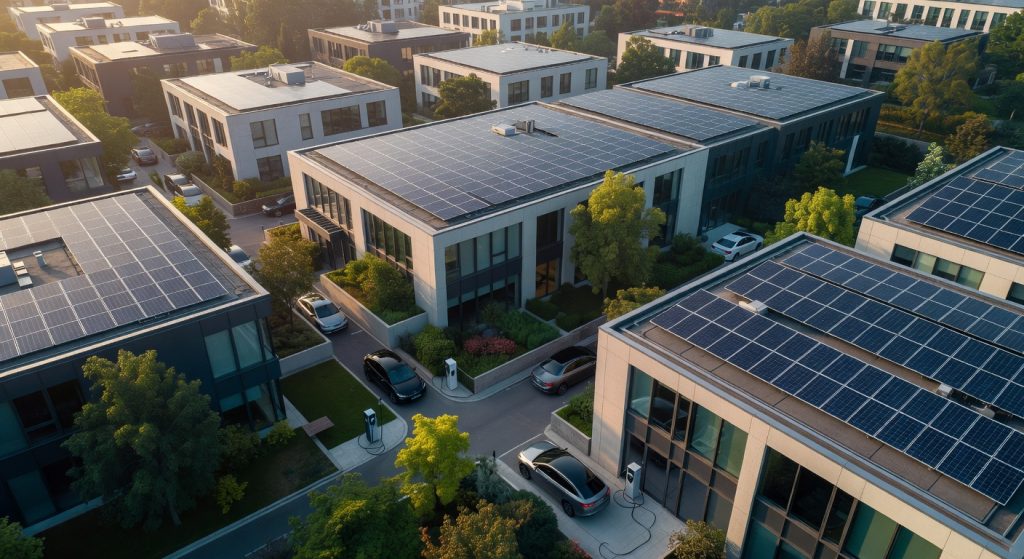
It has been a turbulent and illuminating week for green technology and the global energy transition. On one side of the Atlantic, a landmark regulatory reversal in the United States is sending shockwaves through the cleantech industry. On the other, a series of breakthroughs in solar efficiency, battery technology, and smart urban energy systems are quietly rewriting what is possible. For European citizens, businesses, and policymakers, both signals matter — and the contrast between them could not be starker.
A Solar and Battery Revolution Gathers Pace
The headline figure from the world of materials science is hard to ignore: a new molecular additive has pushed silicon-perovskite tandem solar cells to a record 32.76% efficiency. To put that in context, conventional silicon panels — the kind covering rooftops across Italy, Germany, and Spain — typically operate at around 20–22% efficiency. This leap, achieved by engineering the interface between two light-absorbing layers, brings us significantly closer to the theoretical ceiling for solar conversion and could dramatically reduce the land and cost required to generate clean electricity at scale.
Meanwhile, electric mobility is evolving beyond the car. Researchers are now demonstrating that EVs functioning as mobile batteries — a concept known as vehicle-to-grid (V2G) — could allow tropical cities to run almost entirely on solar power by optimising when vehicles charge and discharge. The benefits are tangible: cleaner air, lower household energy costs, and more resilient urban grids. European cities from Amsterdam to Lisbon are already piloting V2G schemes, and this research strengthens the case for accelerating those programmes.
On the mobility hardware front, BMW has announced a partnership with Rimac to develop sixth-generation batteries boasting a 20% higher energy density, debuting in the new 7 Series. Higher energy density means longer range, faster charging, and lighter packs — addressing the three most common consumer objections to electric vehicles. For Europe’s automotive sector, which is navigating the twin pressures of Chinese competition and tightening EU emissions targets, partnerships like this signal that premium green innovation remains a viable competitive strategy.
Affordable Innovation for Homes and Buildings
Not every breakthrough requires a laboratory or a luxury car. Photothermal fabric panels — textile-based surfaces that absorb solar radiation and convert it to heat — have been shown to cut building heating energy consumption by up to 23%. This is particularly relevant for Europe, where heating accounts for roughly 40% of total energy use and where millions of households still rely on gas boilers. Solutions that can be retrofitted affordably, without major structural changes, will be critical to meeting the EU’s renovation wave targets and reducing energy poverty across the continent.
Taken together, these developments paint a picture of a cleantech ecosystem that is maturing rapidly across multiple fronts: generation, storage, mobility, and thermal comfort. The challenge, as always, is scaling these innovations from the lab to the market at the speed the climate crisis demands.
The EPA Reversal: A Warning Signal for Global Climate Policy
Against this backdrop of technological progress, the decision by the US Environmental Protection Agency to reverse its CO2 endangerment finding — the legal cornerstone of American climate regulation since 2009 — represents a serious geopolitical disruption. The finding had underpinned rules limiting emissions from power plants, vehicles, and industrial facilities. Its removal creates immediate regulatory uncertainty for cleantech businesses operating in or exporting to the US market, and risks slowing investment in sectors like data centres, where power demand is surging alongside the growth of artificial intelligence.
For Europe, the implications are double-edged. The EU’s Green Deal and Carbon Border Adjustment Mechanism (CBAM) now look even more strategically important as anchors of global climate ambition. But European exporters and investors with US exposure face a more complex compliance landscape. The divergence in regulatory direction between Brussels and Washington is widening — and businesses will need to plan accordingly.
What This Means for Europe’s Green Transition
- Accelerate domestic clean energy deployment — record solar efficiency and photothermal materials offer real tools for the renovation wave and energy independence.
- Invest in smart grid infrastructure — V2G technology and smart cities strategies can turn Europe’s growing EV fleet into a distributed energy asset.
- Maintain regulatory clarity — the US EPA reversal is a cautionary tale; consistent, science-based policy frameworks are themselves a competitive advantage for attracting cleantech investment.
- Support industrial partnerships — collaborations like BMW-Rimac demonstrate that European electric mobility can compete globally when innovation and manufacturing scale are combined.
Key takeaway: The technology for a clean energy future is advancing faster than many expected. The real variable is political will and regulatory consistency. Europe has an opportunity — and a responsibility — to lead by example, both at home and on the world stage.