The EU Green Deal at a Crossroads: Ambition, Simplification, and the Risk of Backsliding
The European Green Deal was launched with a bold promise: to make Europe the world’s first climate-neutral continent by 2050. Yet as 2025 draws to a close, a troubling pattern is emerging. Piece by piece, the legislative foundations of the Green Deal are being quietly renegotiated — delayed, exempted, or softened — in the name of competitiveness and simplification. The question now is whether Europe is streamlining its green transition or slowly hollowing it out.
Simplification or Deregulation? The Devil Is in the Details
The European Commission has moved to exempt all but the largest companies from key environmental reporting obligations and supply chain due diligence requirements. Officially, this is framed as administrative relief — not deregulation. But critics argue the distinction is becoming increasingly difficult to defend in practice.
These changes directly affect sustainability reporting standards that were designed to bring transparency to corporate environmental performance. Fewer companies disclosing emissions data means less accountability across supply chains, and potentially less pressure on mid-sized businesses to align with climate policy goals. For investors and procurement teams relying on ESG data to make decisions, the gaps could be significant.
According to a Delors Centre analysis, this pattern of legislative revision — delaying carbon markets pricing mechanisms, reducing investment support, and blurring green standards — risks eroding both Europe’s credibility and its long-term industrial competitiveness. The irony is sharp: measures intended to protect European businesses from regulatory burden may ultimately undermine the innovation edge that a consistent green framework was meant to build.
Progress on Paper, Gaps on the Ground
The picture is not entirely bleak. The EU Green Policy Tracker (January 2025) records real legislative momentum: of 168 European Green Deal initiatives proposed, 98 have been formally adopted, 37 are still under negotiation, and only 5 have been withdrawn. Countries like Sweden and Estonia are cited as implementation leaders, demonstrating that ambition and execution can go hand in hand.
Renewables are scaling up, and a July 2025 assessment confirms that several EGD targets remain broadly on track. The Carbon Border Adjustment Mechanism (CBAM) is set for full rollout by 2026, which could reshape global trade dynamics by pricing the carbon content of imports into Europe.
However, a critical shortfall looms. National Energy and Climate Plans (NECPs) submitted by member states project a collective 51% reduction in greenhouse gas emissions by 2030 — falling short of the legally binding 55% target. This gap between national commitments and EU-level ambition is not a minor discrepancy; it is a structural problem that no amount of headline-level optimism can paper over. A revision of the Energy Taxation Directive has also been flagged as a necessary lever to accelerate the renewables transition, yet progress remains slow.
Industrial Innovation: Where Green Policy Still Delivers
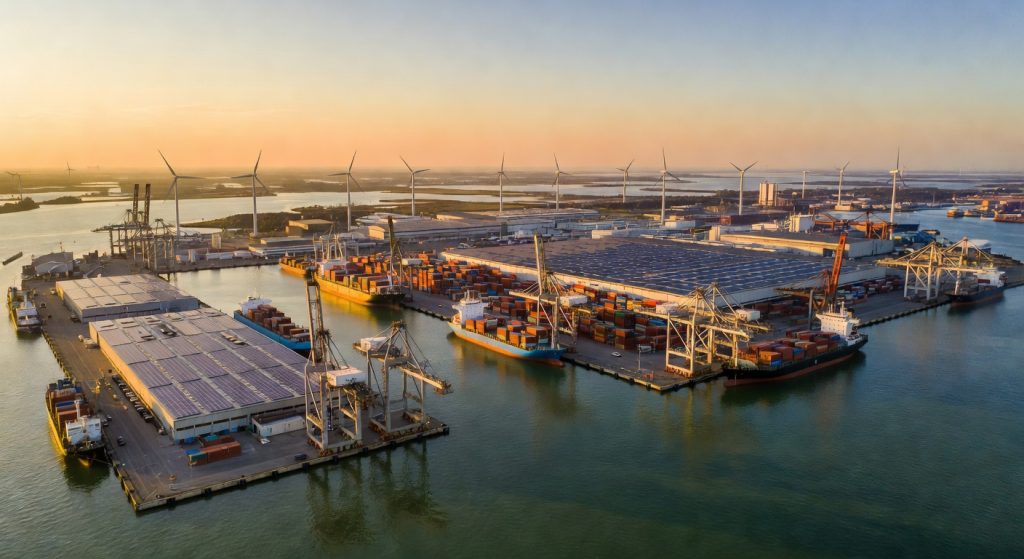
Amid the political turbulence, concrete green transitions are happening at the industrial level. The Port of Rotterdam — Europe’s largest — has signed a major agreement to deploy shore power infrastructure, allowing docked ships to plug into the electrical grid rather than run their diesel engines. This single initiative will cut significant ship-related air pollution and fossil fuel consumption, reinforcing Europe’s position as a leader in clean maritime logistics.
Such projects illustrate what coherent environmental regulation combined with targeted investment can achieve. They also highlight a broader truth: the green transition is not just a cost to be managed, but a source of competitive advantage — in ports, in clean technology manufacturing, and in the global race to decarbonise heavy industry.
What This Means for Europe’s Green Future
The stakes of the current moment extend well beyond Brussels. As the United States recalibrates its own climate commitments and China accelerates clean energy deployment, Europe’s ability to maintain a credible, consistent EU Green Deal framework will determine whether it leads or follows in the global green economy.
- For businesses: Regulatory uncertainty makes long-term investment planning harder, not easier.
- For citizens: Weakened reporting standards reduce visibility into corporate environmental impact.
- For policymakers: The 55% emissions target requires closing the gap between national plans and EU law — urgently.
The key takeaway is this: simplification and ambition are not inherently incompatible, but the current trajectory demands vigilance. Streamlining bureaucracy is legitimate; dismantling the accountability architecture of the green transition is not. Europe’s credibility — with its own citizens, with global partners, and with the climate itself — depends on holding that line.