Green Hydrogen and Solar Power Are Reshaping Europe’s Energy Future in 2025
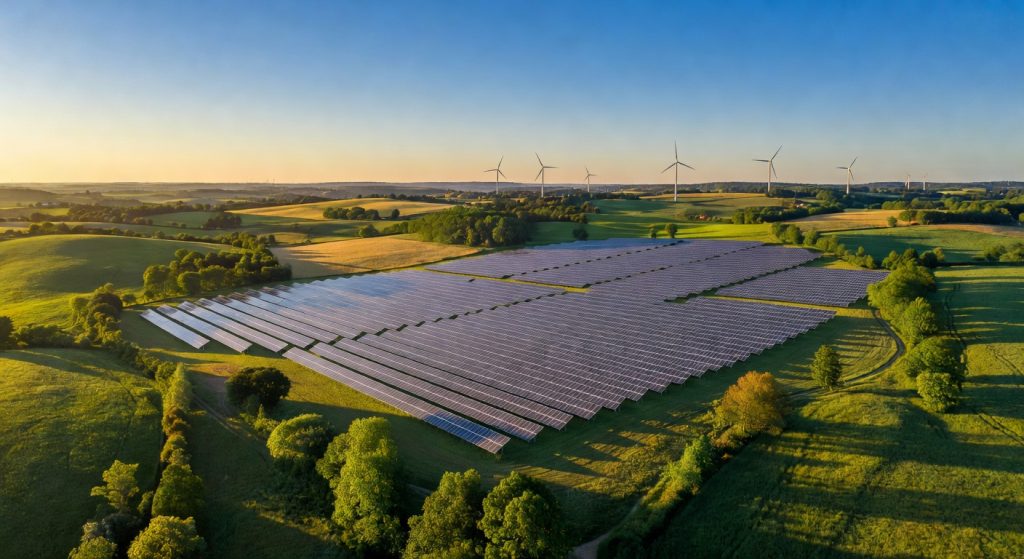
Europe’s clean energy transition is no longer a distant ambition — it is happening now, project by project, gigawatt by gigawatt. A wave of recent developments in green hydrogen, solar power, and renewable energy economics is reshaping how the continent produces and consumes energy, with implications that extend well beyond the energy sector into jobs, resource management, and long-term climate resilience.
The UK Bets Big on Green Hydrogen
In a landmark step for clean energy infrastructure, the UK government has confirmed that 10 commercial-scale green hydrogen projects have signed long-term contracts through the country’s first Hydrogen Allocation Round (HAR1). These agreements provide the revenue certainty that developers need to move from planning to construction — a critical unlock for a technology that has long struggled to compete on cost with fossil-fuel alternatives.
Green hydrogen, produced by splitting water through electrolysis powered by renewable electricity, is considered essential for decarbonising hard-to-electrify sectors such as heavy industry, shipping, and long-haul transport. The HAR1 contracts signal that the UK is serious about building a domestic hydrogen economy, not just a policy framework.
The momentum is not limited to the UK. Swiss clean energy firm Smartenergy has secured €82.5 million in funding for its 100MW Orange.Bat green hydrogen project, demonstrating that private capital is increasingly willing to back hydrogen at scale when the right financial structures are in place. Together, these developments suggest that Europe’s hydrogen sector is moving from pilot projects into genuine industrial deployment.
Solar Power Hits New Milestones Across Europe
While hydrogen grabs headlines, solar energy continues its remarkable expansion across the continent. Germany — Europe’s largest economy and a bellwether for energy policy — has now reached halfway to its 2030 solar target of 215 GW, a milestone that reflects years of sustained investment and regulatory support. For businesses operating in the German market, this trajectory signals both expanding opportunities in solar installation and supply chains, and a grid that will increasingly run on clean electricity.
Across the Channel, the UK has published an ambitious solar roadmap for 2030, aimed at widescale deployment to strengthen energy security and reduce costs for households and businesses alike. The policy push comes at a time when distributed solar — rooftop panels on homes, farms, and commercial buildings — is proving to be one of the most cost-effective tools for democratising energy production and improving local resource management.
These national roadmaps are part of a broader European drive to reduce dependence on imported fossil fuels, a priority that has only intensified since the energy crisis triggered by Russia’s invasion of Ukraine in 2022.
Renewables Are Now Cheaper Than Fossil Fuels — Almost Everywhere
Perhaps the most consequential data point underpinning all of these developments comes from the International Renewable Energy Agency (IRENA): 91% of new renewable energy capacity added globally in recent years is now cheaper than fossil fuel alternatives. This is not a marginal difference — in many markets, solar and wind are the cheapest sources of new electricity generation available, full stop.
The economic argument for clean energy is no longer a projection. It is a present reality. For decision-makers in both the public and private sectors, this fundamentally changes the calculus around energy investment. Choosing fossil fuels over renewables increasingly means choosing higher costs, not lower ones.
- Solar and wind are driving down wholesale electricity prices in liberalised markets.
- Green hydrogen costs are falling as electrolyser technology matures and renewable electricity becomes cheaper.
- Energy efficiency investments are delivering faster returns as the price of clean power drops.
What This Means for Citizens, Businesses, and Policymakers
For ordinary citizens, these trends point toward lower energy bills over time — provided that infrastructure investment keeps pace and that cost savings are passed through fairly. For businesses, the window to lock in competitive energy costs through long-term renewable contracts or on-site solar generation is wide open. For policymakers, the challenge is no longer whether clean energy works, but how to accelerate permitting, grid upgrades, and water and resource management frameworks to support the pace of deployment that the climate requires.
Europe is not moving uniformly — some member states are advancing faster than others — but the direction of travel is clear and, increasingly, irreversible.
Key takeaway: The convergence of falling renewable costs, ambitious national roadmaps, and maturing hydrogen markets means Europe’s clean energy transition has entered a new, faster phase. The question is no longer if, but how quickly institutions and industries can adapt to capture its full benefits.