Clean Energy Acceleration in 2026: How AI Demand, Corporate Commitments, and Grid Innovation Are Reshaping the Global Transition
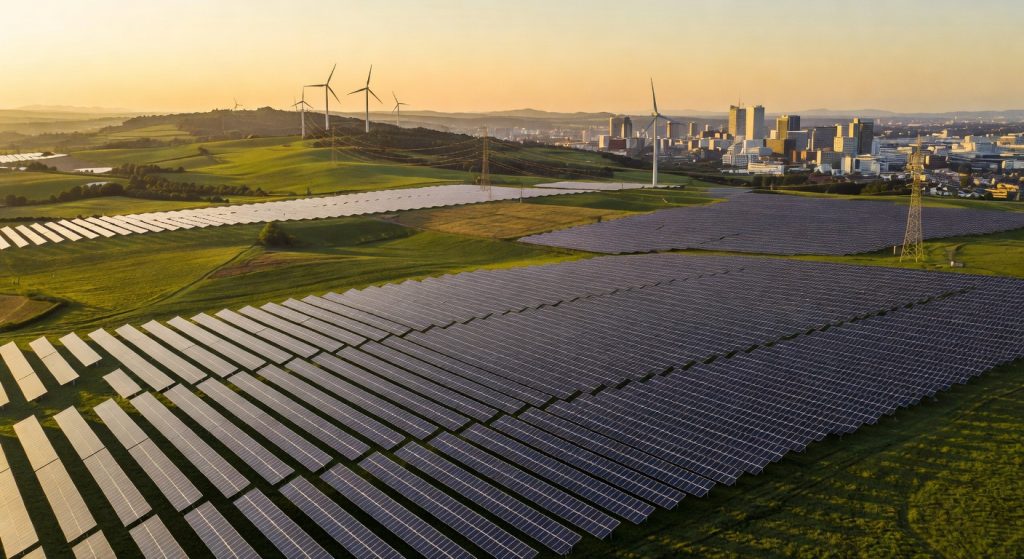
The energy transition is no longer a distant ambition — it is happening at measurable, accelerating speed. A wave of reports published in early 2026, including the We Mean Business Coalition’s ‘Signals of Change – March 2026’ and J.P. Morgan’s latest Climate Tech analysis, paint a consistent picture: green technology is moving from niche investment to core infrastructure, driven by a convergence of energy security concerns, corporate commitments, and an unexpected catalyst — the explosive power demand of artificial intelligence.
Renewables Hit New Milestones — From Spain to Australia
The headline numbers are striking. Australia’s electricity grid has crossed the 50% renewables threshold, stabilised by a growing fleet of grid-scale batteries. Spain has doubled its solar and wind capacity, a move driven not only by climate targets but by a strategic push for energy independence in the post-Ukraine geopolitical landscape. In the United Kingdom, the country’s first deep geothermal plant has come online, supplying clean heat and power to 10,000 homes — a modest but symbolically important step for a technology long overshadowed by wind and solar.
These are not isolated data points. They reflect a structural shift in how governments and grid operators think about energy security. For Europe in particular, the lesson of recent years has been clear: dependence on imported fossil fuels is a strategic vulnerability. Renewables, paired with storage and smart grid innovation, are increasingly the answer — not just environmentally, but economically and geopolitically.
AI’s Energy Appetite Is Turbocharing Cleantech Investment
One of the most significant — and somewhat paradoxical — drivers of the current green innovation boom is artificial intelligence. Data centres powering AI workloads are projected to drive a 130% increase in US electricity demand by 2030, according to investor analysis cited in recent cleantech reports. This surge is forcing technology companies to secure long-term clean power supplies at scale.
The results are visible in the market. Fervo Energy, a geothermal startup, has raised $462 million and signed landmark deals with Google to power AI data centres with next-generation geothermal energy. TIME’s ranking of America’s Top 250 GreenTech Companies for 2026 places geothermal and solar firms at the top, reflecting where capital and confidence are flowing. Meanwhile, Sunrun is pioneering vehicle-to-grid (V2G) technology in partnership with Ford and Tesla, turning electric vehicles into distributed grid assets — a critical innovation for managing the volatility that comes with high renewable penetration.
J.P. Morgan’s Climate Tech Report notes that 2025 venture activity remained steady despite macroeconomic headwinds, with investment shifting decisively toward grid technology, battery storage, and critical minerals — the infrastructure layer that makes the energy transition physically possible. Europe’s focus at the Clean Tech Stars Conference echoed this: energy security and renewables are now inseparable priorities for the continent.
Corporate Commitments: From Pledges to Procurement
Beyond the infrastructure story, corporate action is deepening. The We Mean Business Coalition reports that 445 companies have joined RE100, committing to 100% renewable electricity, while 116 firms are in EV100, pledging full electric vehicle fleets. Even harder-to-abate sectors are moving: 36 companies have signed up to ConcreteZero, targeting net-zero concrete by mid-century.
Individual corporate milestones illustrate the trend. ABB has cut emissions in its manufacturing operations by 97%, and Nike has signed a solar power purchase agreement (PPA) in Japan — a market where corporate renewable procurement has historically been difficult. These are not PR exercises; they represent real procurement decisions reshaping energy markets.
What This Means for Europe and Beyond
For European citizens, professionals, and policymakers, the implications are layered. The energy transition is creating genuine economic opportunity — in manufacturing, grid services, electric mobility, and smart city infrastructure. But it also demands policy coherence: permitting reform, grid investment, and skills development must keep pace with the speed of technological change.
The nuclear question remains open. Investor sentiment is divided following a 2025 funding surge, and the technology’s role in a high-renewables grid is still being debated across European capitals.
Key takeaway: The clean energy transition in 2026 is being accelerated by an unlikely alliance of climate ambition, energy security imperatives, and digital infrastructure demand. Green innovation is no longer waiting for policy — in many cases, it is running ahead of it. The challenge now is ensuring that the systems, regulations, and social frameworks needed to support this transformation can keep up.