EU Green Deal at a Crossroads: Can Europe Balance Competitiveness With Its Climate Commitments?
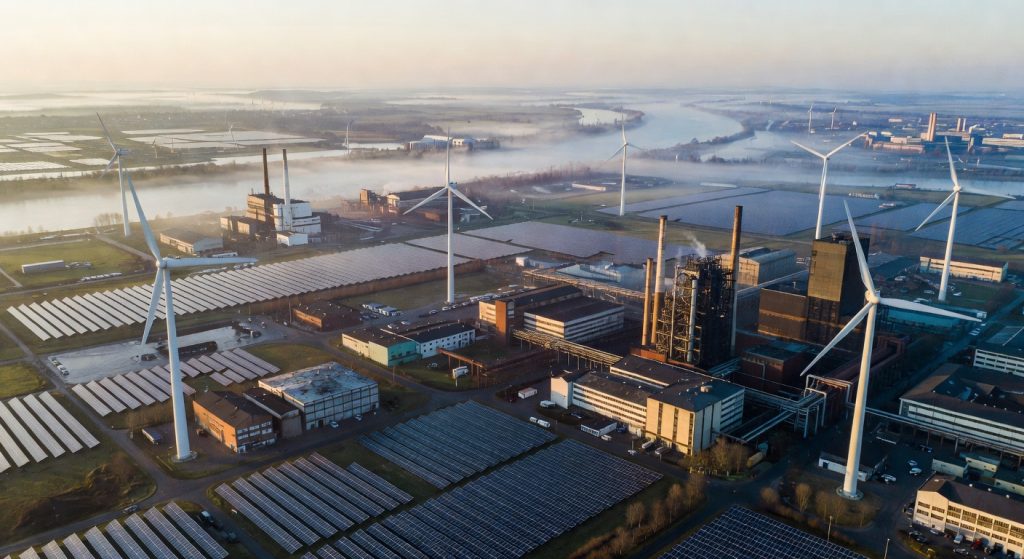
Five years after its launch, the European Green Deal is facing its most serious stress test yet. Faced with sluggish economic growth, rising energy costs, and mounting pressure from industry lobbies, the European Commission has begun rolling back or delaying several cornerstone environmental regulations — from deforestation rules to corporate sustainability reporting requirements. The question now is whether Europe can remain a credible climate leader while simultaneously chasing industrial competitiveness.
Green Rules in Retreat: What Is Being Rolled Back and Why
The list of policy retreats is growing. The EU’s landmark deforestation regulation, which would have required companies to prove their supply chains are not linked to forest destruction, has been significantly delayed. The Corporate Sustainability Due Diligence Directive (CSDDD), designed to hold large companies accountable for environmental and human rights impacts across their value chains, has been watered down. Meanwhile, reforms to the EU Emissions Trading System (ETS) — the bloc’s primary carbon pricing mechanism — are being scrutinised with fresh scepticism.
The stated rationale is competitiveness. The Draghi report on European competitiveness, published in late 2024, warned that the EU risks falling behind the United States and China if regulatory burdens are not eased. But critics argue this logic penalises companies that invested early in green transitions, undermines market confidence in carbon pricing, and sends a damaging signal to global partners watching Europe’s every move on climate policy.
An assessment of 74 Green Deal policies, cited by researchers tracking SDG alignment, found that while the framework performs strongly on climate-related goals, it neglects social dimensions such as poverty reduction and inequality — a structural weakness that could erode public and political support over time.
2026: The Year That Will Define Europe’s Post-2030 Climate Path
Despite the current turbulence, the institutional calendar makes 2026 a pivotal year for EU environmental regulation. Several processes will unfold simultaneously:
- The European Commission is set to review the ETS and begin preparing post-2030 rules, which will shape carbon markets for decades to come.
- Budget negotiations for the 2028–2034 Multiannual Financial Framework are expected to include a 35% climate spending target — a figure that will be fiercely contested.
- The Industrial Accelerator Act, the Circular Economy Act, and the Innovation Act are all in preparation, aiming to align industrial strategy with decarbonisation goals.
- On 5 March 2026, the EU Clean Energy Transition Conference will convene to address scaling renewables, electricity grids, green hydrogen, and energy affordability following the Action Plan for Affordable Energy.
The outcome of these processes will determine whether the Green Deal’s core architecture survives or is gradually hollowed out by short-term economic logic. The Carbon Border Adjustment Mechanism (CBAM) is also transitioning into its definitive phase, representing one of the few green instruments that appears politically resilient — partly because it doubles as a trade tool.
What the Rollbacks Mean for Investors, Businesses, and Citizens
The erosion of regulatory certainty is already having real-world consequences. Businesses that made costly investments in sustainability reporting infrastructure, green supply chains, or low-carbon technologies are now watching competitors benefit from delayed obligations. This creates a perverse incentive structure that rewards inaction and punishes ambition — the opposite of what effective climate policy should do.
For carbon markets, confidence in the ETS depends on the credibility of long-term policy signals. If investors believe that emissions caps will be loosened whenever economic conditions deteriorate, the carbon price loses its power as a decarbonisation driver. According to European Business Magazine, the current policy uncertainty is already shaking ETS confidence among market participants.
For citizens, the stakes are equally high. The EU has set a binding target of reducing net greenhouse gas emissions by at least 55% by 2030 compared to 1990 levels. Rolling back key policies makes that target harder to reach — and the consequences of missing it, from more frequent extreme weather to higher food prices, will be felt most acutely by those least able to adapt.
Key Takeaway
The European Green Deal’s vision remains intact, but it is narrowing. What began as a comprehensive transformation agenda — spanning climate, biodiversity, social equity, and industrial renewal — is increasingly being reduced to a decarbonisation programme, with other goals deprioritised under competitive pressure. The decisions made in 2026 on the ETS, the post-2030 framework, and the EU budget will be defining moments. Europe still has the tools and the institutional capacity to lead on climate. Whether it has the political will is the open question.