Renewables Overtake Coal: Why Clean Energy Is Now the World’s Best Energy Security Strategy
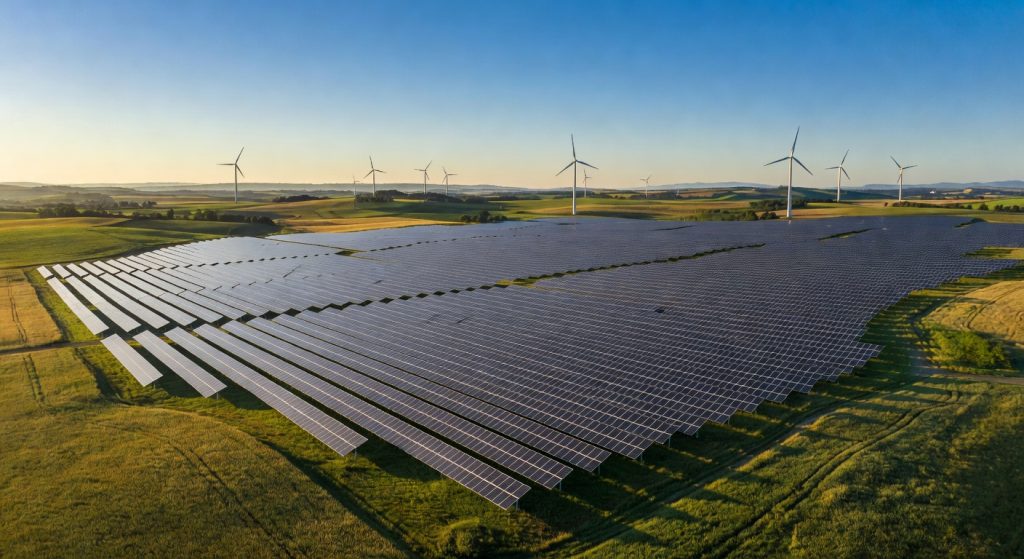
When conflict disrupts oil and gas markets, economies built on fossil fuels feel the shock almost immediately — at the pump, on energy bills, and across supply chains. But at the 2026 Green Growth Summit in Brussels, UN climate chief Simon Stiell made a point that is becoming harder to ignore: countries that have invested in renewable energy are increasingly insulated from that volatility. And the numbers back him up.
In 2025, renewables overtook coal as the world’s largest source of electricity for the first time in history. Over $2 trillion was invested in clean energy globally — double the investment flowing into fossil fuels. This is not a distant green future. It is the energy landscape of today.
A Geopolitical Argument for the Clean Energy Transition
The ongoing conflict in the Middle East has once again pushed oil and gas prices higher, reviving anxieties about energy supply chains that Europe knows all too well since Russia’s invasion of Ukraine in 2022. Yet this latest shock is landing differently in countries that have moved decisively toward solar and wind energy.
Spain is a compelling European example. Over the past six years, the country has doubled its solar and wind capacity, dramatically reducing its exposure to fossil fuel price swings. When gas prices spike, Spanish consumers and industries are far less vulnerable than they were a decade ago. This is the real dividend of long-term clean energy investment: not just lower emissions, but genuine energy security.
The EU’s broader push for energy independence — accelerated by the REPowerEU plan — reflects the same logic. Diversifying away from imported fossil fuels through domestic renewable generation, improved energy efficiency, and smarter resource management is no longer just an environmental choice. It is a strategic one.
Solar and Storage: The Engine of the New Energy Economy
Nowhere is the pace of transition more visible than in solar deployment and battery storage. In the United States, utility-scale solar is forecast to add a record 43.4 GW of new capacity in 2026 — representing 51% of all new power generation and a 60% year-on-year increase. These are not incremental gains; they represent a structural shift in how electricity systems are built.
Battery storage is scaling just as fast. US operating storage capacity reached 37.4 GW by October 2025, up 32% in a single year, with a pipeline of 187 GW projected by 2030 — more than half of it paired directly with solar installations. Storage is the critical enabler that transforms solar and wind from intermittent sources into reliable, round-the-clock power providers.
Australia offers another milestone worth noting. Its largest grid recently met record electricity demand while renewables supplied over 50% of power, supported by millions of rooftop solar panels and a rapidly expanding battery fleet. The 50% threshold — once a symbolic target — is now a lived operational reality.
What This Means for Europe and the Path Ahead
For European citizens, professionals, and policymakers, these global trends carry clear implications. The competitiveness gap between fossil-dependent and renewables-led economies is widening. Countries and regions that accelerate deployment of solar, wind, and storage — while investing in hydrogen for hard-to-decarbonise sectors and improving energy efficiency across buildings and industry — will be better positioned economically, geopolitically, and climatically.
There are also resource dimensions to consider. The clean energy transition requires careful water management (solar and wind consume far less water than thermal power plants), responsible sourcing of critical minerals, and integrated land-use planning. A genuinely sustainable transition demands attention to these systemic factors, not just headline gigawatt figures.
- Renewables overtook coal globally as the top electricity source in 2025
- Clean energy attracted $2 trillion in investment — double fossil fuels
- Spain doubled solar and wind capacity in six years, boosting energy resilience
- US battery storage capacity grew 32% in 2025, with 187 GW in the pipeline by 2030
- Australia’s grid hit 50%+ renewable supply during peak demand
The key takeaway is straightforward: renewable energy is no longer a climate argument alone. It is an energy security argument, an economic argument, and increasingly, a geopolitical one. As fossil fuel markets remain hostage to conflict and instability, the economies moving fastest toward clean power are building a structural advantage — one measured not just in tonnes of CO₂ avoided, but in resilience, independence, and long-term stability.