EU Climate Policy at a Crossroads: What the 2026 Green Deal Review Reveals
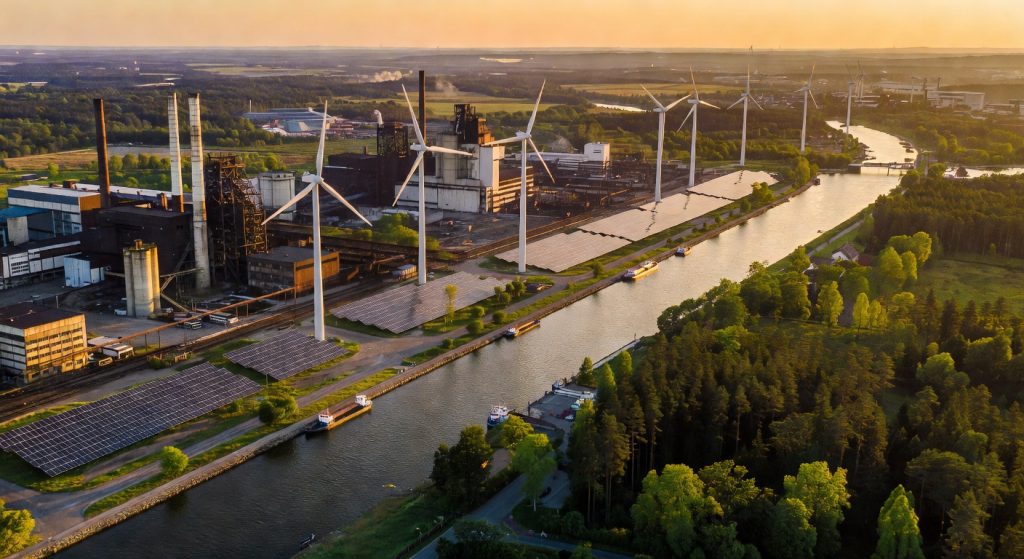
Five years after the European Green Deal was launched with sweeping ambition, 2026 is shaping up to be one of the most consequential years for EU climate policy since the framework’s inception. A major review published in February, a bold new industrial proposal tabled in March, and mounting pressure on core environmental regulations are forcing a fundamental question: is Europe doubling down on its green commitments, or quietly retreating from them?
The Five-Year Review: Progress, Gaps, and Growing Pressure
The European Commission’s five-year assessment of the EU Green Deal, published on February 26, 2026, offers a mixed picture. On one hand, renewable energy capacity has expanded significantly across member states, and the EU Emissions Trading System (ETS) has matured into one of the world’s most robust carbon markets. On the other hand, the review acknowledges persistent structural gaps — particularly in sectors like transport, agriculture, and buildings, which remain among the hardest to decarbonise.
Perhaps more telling than what the review celebrates is what it quietly flags as at risk. Deforestation regulations have faced rollbacks, sustainability reporting obligations under the Corporate Sustainability Reporting Directive (CSRD) have been scaled back for smaller companies, and the expansion of carbon markets to cover road transport and residential heating — a cornerstone of the Fit for 55 package — has been delayed amid political resistance. For businesses and policymakers tracking climate policy signals, these are not minor footnotes. They reflect a broader tension between economic competitiveness and environmental regulation that is increasingly shaping the EU’s legislative agenda.
The Industrial Accelerator Act: Green Ambition or Competitive Compromise?
On March 4, 2026, the European Commission proposed the Industrial Accelerator Act, a legislative package designed to strengthen European production capacities in strategic sectors including steel, cement, chemicals, and automotive manufacturing. The proposal responds directly to competitive pressures from the United States — where the Inflation Reduction Act continues to attract green investment — and from China’s dominant position in clean technology supply chains.
Supporters argue the Act is a necessary evolution of the EU Green Deal: you cannot decarbonise European industry if that industry relocates outside Europe. Critics, however, warn that the proposal risks diluting environmental regulation standards in the name of industrial pragmatism. Key concerns include:
- Potential fast-tracking of permits for heavy industry projects, which could bypass rigorous environmental impact assessments
- State aid flexibility that may favour incumbent fossil-fuel-adjacent industries over genuinely clean alternatives
- A risk of weakening the Carbon Border Adjustment Mechanism (CBAM) as a lever for global climate ambition
The debate around the Industrial Accelerator Act is, in many ways, a microcosm of the broader tension defining EU Green Deal politics in 2026: how to remain a global climate leader while keeping European industry competitive in an increasingly fragmented world economy.
Carbon Markets and Sustainability Reporting: The Regulatory Battleground
Two of the most technically significant fronts in 2026’s climate policy landscape are carbon markets and sustainability reporting. The ETS remains Europe’s most powerful decarbonisation tool, but the delayed rollout of ETS2 — covering buildings and road transport — has created uncertainty for investors and urban planners alike. With post-2030 climate rules currently under negotiation, the architecture of the next phase of carbon pricing is still far from settled.
Meanwhile, the partial retreat from mandatory sustainability reporting requirements signals a shift in how the EU balances corporate accountability with administrative burden. While large listed companies remain subject to CSRD obligations, the narrowing of scope reduces the systemic visibility that investors and civil society organisations rely on to track real-world progress. For the EU’s ambition to align financial flows with the Paris Agreement, this is a meaningful step backward.
Implications: What This Means for Citizens, Business, and the Planet
For citizens, the policy turbulence of 2026 translates into real uncertainty: will carbon pricing eventually raise energy costs for households? Will environmental protections hold as industrial lobbying intensifies? For businesses, the mixed signals create planning challenges — particularly for companies that have invested heavily in green transition strategies based on regulatory stability. And at a global level, any visible weakening of EU climate ambition risks undermining Europe’s credibility as a standard-setter in international negotiations.
Key takeaway: 2026 is not a year of climate retreat — but it is a year of climate negotiation. The EU Green Deal remains the most comprehensive climate policy framework in the world, but its implementation is being actively contested. The decisions made in Brussels this year, on carbon markets, industrial policy, and sustainability reporting, will define whether Europe’s green decade delivers on its promise or settles for something considerably more modest.