AI’s Energy Hunger Is Reshaping the Power Grid — and Accelerating Green Innovation
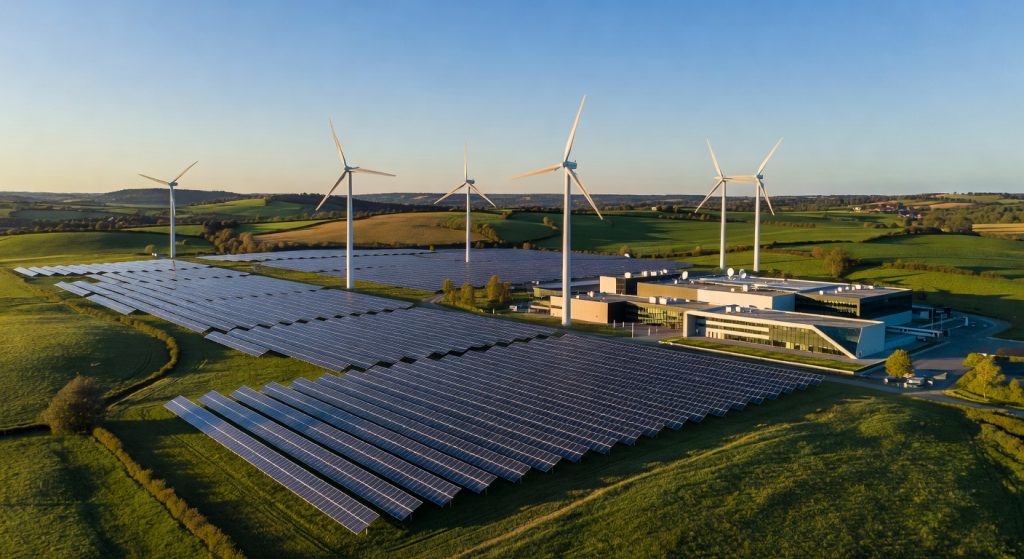
The artificial intelligence boom is not just transforming how we work and communicate — it is placing an unprecedented strain on the world’s electrical grids. In the United States, President Trump has taken the unusual step of directing major technology companies to generate their own electricity for their data centers, a move that signals just how serious the energy infrastructure bottleneck has become. Meanwhile, AI-related power consumption is projected to surge by 175% by 2030, according to recent industry analyses. For Europe, watching these developments unfold is not a spectator sport: the same pressures are building here, and the policy and green technology choices made now will define the continent’s energy future.
The Data Center Energy Crisis: A Global Wake-Up Call
The numbers are staggering. Global data centers already account for roughly 1–2% of total electricity consumption, a share that is growing rapidly as generative AI workloads multiply. In the US, the White House is planning to host major tech companies in early 2025 to formalise a framework for corporate self-sufficiency in power generation — an extraordinary policy pivot that reflects how strained the ageing American grid has become.
Tech giants are not waiting for government direction. Google, Meta, and Microsoft are investing heavily in solar and wind projects, but also in more unconventional solutions. Form Energy’s 100-hour iron-air battery systems, for example, represent a breakthrough in long-duration energy storage — a critical enabler for a grid increasingly dependent on intermittent renewables. Elon Musk’s companies are pursuing full vertical integration, developing proprietary chips for AI, robotics, and space-based data centres to reduce dependency on external supply chains and power infrastructure.
From a European perspective, this corporate race toward energy self-sufficiency is both a warning and an opportunity. The EU’s data centre sector is growing fast, particularly in Ireland, the Netherlands, and the Nordic countries. Grid operators across Europe are already flagging capacity concerns, and the energy transition cannot succeed if digital infrastructure is allowed to grow unchecked without a parallel investment in clean, smart grid technology.
Policy Turbulence: Germany’s Retreat and What It Means for the Energy Transition
Just as the urgency of green innovation has never been greater, political headwinds are complicating the picture. Germany’s newly formed coalition government has scrapped key provisions of its landmark 2023 heating law, abandoning the requirement that new heating systems run on at least 65% renewable energy. The revised target — just 10% climate-friendly fuels by 2029 — represents a significant step backward for one of Europe’s largest economies.
This policy reversal is part of a broader pattern of implementation fatigue across the continent, where ambitious climate legislation meets resistance from voters and industries struggling with rising energy costs. The risk is a dangerous feedback loop: slower deployment of renewables means greater reliance on fossil fuels, which drives up costs and emissions, which in turn fuels further political backlash against climate policy.
Yet the answer is not to slow down the energy transition — it is to make it smarter. Grid modernisation, energy storage, and demand flexibility are not optional extras; they are the foundation without which no renewable energy target can be met sustainably. Smart cities and electric mobility networks, both of which depend on a stable and clean grid, are directly affected by these policy choices.
Green Hydrogen and Storage: The Technologies That Can Bridge the Gap
Amid the turbulence, some encouraging signals are emerging. India is scaling up green hydrogen corridors and grid infrastructure as central pillars of its national energy transition — moving decisively from pilot projects to commercially viable, large-scale deployment. This is a model worth studying in Europe, where green hydrogen ambitions have often stalled at the demonstration phase.
Long-duration energy storage, advanced grid management software, and distributed energy resources are the cleantech solutions that can reconcile the explosive growth of AI infrastructure with net-zero commitments. Investments in these areas are not just environmentally necessary — they are increasingly economically rational, as the cost of grid instability and fossil fuel dependency becomes clearer.
Implications for Europe
- Grid investment must accelerate: The EU’s electricity networks need an estimated €584 billion in upgrades by 2030 to support both renewables and digital infrastructure growth.
- Corporate energy responsibility: European regulators should consider frameworks that require large data centre operators to demonstrate clean power sourcing, not just purchase renewable energy certificates.
- Policy consistency matters: Reversals like Germany’s heating law revision erode investor confidence in the cleantech sector and must be avoided where possible.
Key takeaway: The AI energy crisis is forcing a reckoning with how societies plan and build power infrastructure. For Europe, this is a pivotal moment: double down on green innovation, grid modernisation, and coherent climate policy — or risk being left behind in both the digital and clean energy transitions simultaneously.