Renewables as a Shield: How Clean Energy Is Rewriting the Rules of Energy Security
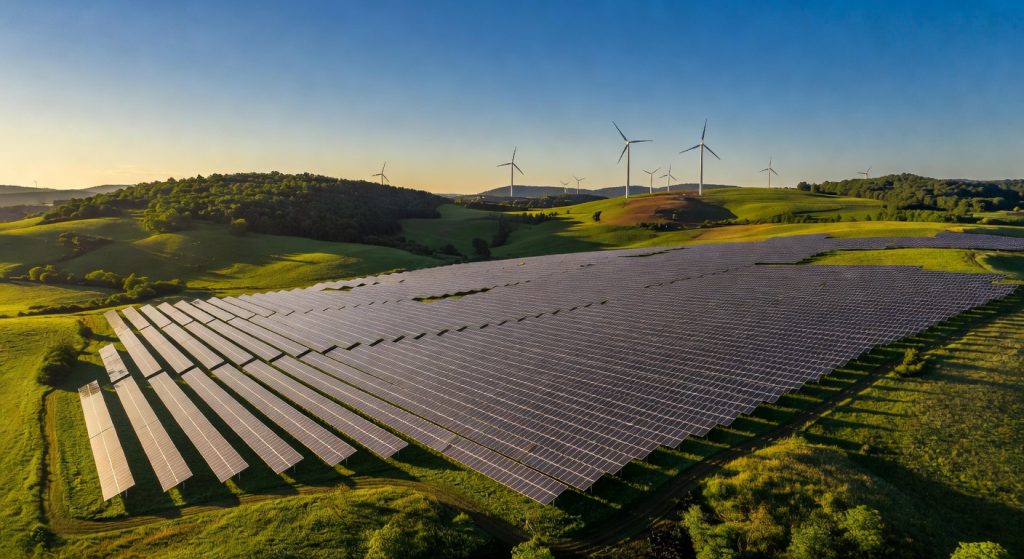
Every time a geopolitical crisis rattles global fossil fuel markets, the same lesson resurfaces with renewed urgency: economies tethered to oil and gas are economies held hostage. The UN’s top climate official made this point forcefully in the wake of war-driven energy price spikes, urging governments and businesses to accelerate the transition to renewable energy — not just for the climate, but for basic economic resilience. The data emerging from Europe, the United States, and beyond suggests that many are finally listening.
Europe Builds Its Defences: Solar, Wind, and Geothermal Lead the Way
Europe’s vulnerability to fossil fuel supply disruptions has, paradoxically, become one of the strongest drivers of its clean energy ambition. Spain stands out as a compelling case study: the country has doubled its solar and wind capacity in just six years, a transformation that is already delivering greater price stability for households and businesses alike. The logic is straightforward — energy generated domestically from sun and wind cannot be embargoed or subjected to the whims of distant commodity markets.
The United Kingdom is pushing the frontier further. The country has launched its first deep geothermal plant, capable of powering around 10,000 homes, while also exploring shallow geothermal energy extracted from disused coal mines — a poetic repurposing of the fossil fuel era’s infrastructure. Meanwhile, Portugal’s EDP, one of Europe’s largest utilities, reported a 44% rise in profits driven by improvements in renewables efficiency, offering a clear signal to investors that the energy transition is not a cost centre but a growth engine.
These developments align with the broader European push for energy efficiency and diversified resource management, reducing dependence on imported gas while cutting emissions across the power sector.
A Global Surge: Records Broken in the US, India, and Australia
The momentum is not confined to Europe. The United States is planning a record 86 GW of new power capacity additions in 2026, with solar alone accounting for 43.4 GW — more than half the total. Wind energy will contribute a further 11.8 GW. The buildout is concentrated in Texas, Arizona, and California, states that are rapidly becoming global benchmarks for large-scale clean energy deployment. For American citizens and businesses, the implications include greater grid reliability and long-term insulation from fossil fuel price volatility.
India’s GREW Solar has secured a $223 million contract for 1.4 GW of solar modules, reflecting the scale of ambition in one of the world’s fastest-growing energy markets. Australia, meanwhile, has reached a landmark moment: its national grid now sources 50% of its electricity from renewables, with rooftop solar panels and home batteries playing a decisive role. This milestone illustrates how distributed generation — energy produced at the level of individual homes — is becoming a structural pillar of modern grids.
In South Africa, US-based Energea’s acquisition of a solar-storage microgrid points to another emerging trend: the use of renewables paired with battery storage to bring reliable electricity to underserved communities, a model with significant implications for resource management in the Global South.
Corporations Step Up: From Nike to RE100
The corporate world is accelerating in parallel. Nike and Mitsui have signed a solar power purchase agreement (PPA) covering 70% of Nike’s electricity needs in Japan — a concrete example of how multinationals are embedding renewable procurement into their core operations. More broadly, 445 companies have now committed to 100% renewable electricity through the RE100 initiative, while 107 have pledged specific energy efficiency targets. These commitments are reshaping supply chains and sending sustained demand signals to clean energy developers worldwide.
What This Means for Citizens, Businesses, and Policymakers
The convergence of geopolitical pressure, falling technology costs, and growing corporate demand is creating a rare alignment of incentives. For European citizens, the expansion of solar, wind, and geothermal means lower exposure to energy price shocks and cleaner air. For businesses, it means predictable energy costs and a pathway to meeting sustainability commitments. For policymakers, the message from the UN climate chief is unambiguous: accelerating the clean energy transition is no longer just an environmental imperative — it is a matter of economic security.
- Spain doubled solar and wind capacity in six years, stabilising prices.
- UK launched its first deep geothermal plant, powering 10,000 homes.
- US targets 86 GW of new capacity in 2026, led by solar (43.4 GW).
- Australia crossed the 50% renewables milestone on its national grid.
- 445 companies globally have committed to 100% renewable electricity via RE100.
Key takeaway: Renewable energy is no longer simply the sustainable choice — it is increasingly the strategically rational one. Countries and companies that move fastest are building not just cleaner systems, but more resilient ones.