Green Tech Breaks Records in 2025: How the Clean Energy Transition Is Reshaping Europe and the World
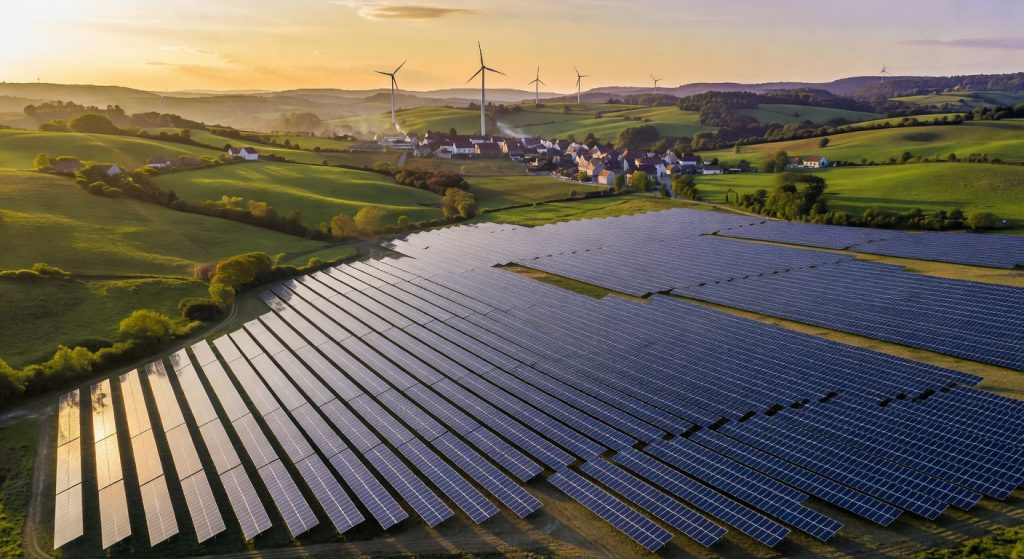
The numbers are in, and they are hard to ignore. Global investment in green technology reached a record $2.3 trillion in 2025, an 8% increase over the previous year, according to data compiled by the We Mean Business Coalition. From Spain’s solar expansion to Australia’s grid milestones and the UK’s first deep geothermal plant, the signals of a genuine, accelerating energy transition are multiplying — and Europe is leading from the front.
Europe Invests Big, and the Numbers Show It
Of the record global total, the European Union contributed $455 billion — an 18% year-on-year increase — cementing its position as a global hub for green innovation. The bulk of worldwide spending, roughly $1.2 trillion, flowed into renewables and grid infrastructure, while electric mobility attracted $893 billion, reflecting the unstoppable momentum behind the electrification of transport.
This wave of capital is not just an abstract financial statistic. It translates into more resilient supply chains, greater energy independence, and tangible protections against the price volatility that fossil fuel markets have repeatedly inflicted on European households and businesses. Spain offers a vivid example: the country doubled its solar and wind capacity precisely to insulate itself from fossil fuel shocks — a strategy that is now paying dividends for both citizens and industry.
On the corporate side, the momentum is equally striking. 12,882 companies have now aligned their emissions reduction targets with science through the Science Based Targets initiative (SBTi), while 445 businesses have committed to 100% renewables via RE100 and 116 are accelerating EV adoption through the EV100 initiative. Companies like ABB have achieved a 97% cut in emissions, and Nike’s solar power purchase agreement demonstrates how large brands are actively driving cleantech deployment at scale.
Geothermal, AI, and the Next Frontier of Clean Power
Beyond solar and wind, advanced geothermal energy is emerging as a critical piece of the puzzle — particularly for providing stable, round-the-clock baseload power. The UK commissioned its first deep geothermal plant, now powering 10,000 homes, while in the United States, Fervo Energy — backed by Google — is pioneering geothermal solutions tailored to the soaring electricity demands of data centres.
This last point matters enormously. The explosive growth of artificial intelligence is creating unprecedented pressure on electricity grids, and the cleantech sector is responding with a suite of innovations: liquid cooling systems for data centres, solid-state transformers, and AI-powered grid management tools such as GridCARE. These technologies are not only reducing the carbon footprint of the digital economy but also enhancing grid reliability for utilities and everyday citizens living in smart cities.
Australia’s grid reaching the 50% renewables milestone — driven by rooftop solar and battery storage — illustrates what is achievable when policy, technology, and public adoption converge. It is a model that European cities and regions are watching closely as they design their own pathways to decarbonisation.
Cleantech Companies Setting the Benchmark
A new generation of cleantech firms is redefining what industrial sustainability looks like in practice:
- First Solar produces panels with 40% lower lifecycle emissions than conventional alternatives and a 90% recycling rate — a benchmark for circular economy principles in manufacturing.
- Bloom Energy deploys fuel cells operating at up to 60% efficiency, with near-zero emissions when running on hydrogen, offering a viable path for hard-to-electrify industrial applications.
- Plug Power has deployed over 60,000 hydrogen systems globally, cutting fleet emissions by 30% and supporting the decarbonisation of logistics and heavy industry.
These are not pilot projects. They are scaled, commercial solutions already reshaping industrial supply chains — including in Europe, where hydrogen and fuel cell technology are central to the EU’s industrial decarbonisation strategy.
What This Means for Citizens, Businesses, and Policymakers
The convergence of record investment, corporate commitment, and technological maturity sends a clear message: the energy transition is no longer a distant aspiration — it is an economic reality unfolding in real time. For European decision-makers, the priority is now to ensure that regulatory frameworks keep pace with innovation, that grid infrastructure is modernised to absorb growing renewable capacity, and that the benefits of green innovation reach communities across the continent, not just major urban centres.
Key takeaway: With $455 billion invested in Europe alone in 2025 and transformative technologies scaling rapidly, the clean energy transition is delivering measurable results. The challenge ahead is not whether the transition is possible — it clearly is — but whether policy ambition and social equity can match the speed of technological change.