Green Tech Investments Hit $2.3 Trillion in 2025: What It Means for Europe and the Planet
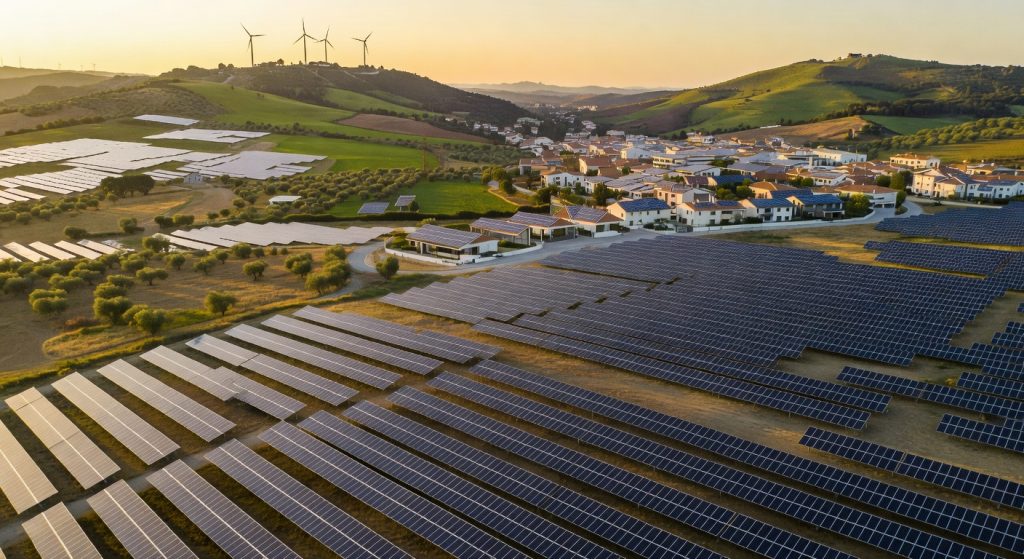
Despite political turbulence, trade tensions, and a slowdown in US climate policy, the world poured a record $2.3 trillion into green technology in 2025 — an 8% increase over the previous year, according to BloombergNEF data reported by the LA Times. Renewables and grid infrastructure attracted $1.2 trillion, while electrified transport claimed $893 billion. The message is clear: the energy transition is no longer a policy ambition. It is an economic reality.
Europe Accelerates While Asia Leads
Asia Pacific dominated global cleantech investment, accounting for nearly half of all capital deployed. But Europe’s performance stands out for its momentum: the EU recorded an 18% surge to $455 billion, outpacing global growth and signalling that European industry and governments are doubling down on the green transition even as geopolitical pressures mount.
The numbers on the ground back this up. Spain has doubled its solar and wind capacity in just six years, insulating its economy from the fossil fuel price shocks that destabilised energy markets after 2022. The UK, meanwhile, has inaugurated its first deep geothermal plant, now powering around 10,000 homes — a modest but symbolically important step toward diversifying the continent’s clean energy mix. These are not isolated experiments. They are proof points of a continental strategy taking shape in real infrastructure.
Corporate Europe is also moving. ABB, the Swiss-Swedish industrial giant, has cut its operational emissions by an extraordinary 97% through electrification. Globally, more than 12,000 companies have aligned their emissions reduction targets with science through the Science Based Targets initiative (SBTi), with 116 specifically accelerating their transition to electric mobility. Green innovation is increasingly a boardroom imperative, not just a sustainability report footnote.
AI: Climate Hero or Greenwashing Machine?
The most contested storyline in cleantech right now is the role of artificial intelligence. Big Tech companies have been accused of systematic greenwashing: while marketing AI as a tool for sustainability, their data centres — many still powered by fossil fuels — are driving emissions upward with no verified substantial reductions to offset them. Data centre energy consumption is projected to quadruple by 2030, raising urgent questions about whether the digital economy can be decarbonised fast enough.
Yet the picture is genuinely dual. AI is also emerging as a critical enabler of smart grid optimisation, helping operators balance increasingly complex networks fed by variable renewable sources. Advanced geothermal energy — long considered too expensive and technically difficult to scale — is surging precisely because AI-assisted drilling and subsurface modelling are making it viable. Companies like Fervo Energy, backed by Google, are pioneering next-generation geothermal projects designed specifically to provide clean baseload power for data centres. Liquid cooling systems, solid-state transformers, and AI-powered grid sensors are among the innovations expected to define the 2026 cleantech outlook.
The challenge for regulators — particularly in Europe, where the EU AI Act and Green Deal intersect — is to hold tech companies accountable for their actual emissions footprint while creating the conditions for AI-enabled green innovation to flourish.
What This Means for Citizens and Decision-Makers
Record investment in the energy transition translates into tangible outcomes for ordinary people. More renewables on the grid means greater energy security and price stability — a lesson Europeans learned painfully during the 2022 gas crisis. The growth of electric mobility is reshaping urban transport, with implications for air quality, noise pollution, and the design of smart cities. Rooftop solar paired with home batteries — as seen in Australia, where the grid has crossed the 50% renewables milestone — points toward a future where citizens are active participants in energy production, not just consumers.
For businesses, the resilience argument is becoming dominant. Supply chains built around electrification and domestic renewable energy are proving more stable than those dependent on imported fossil fuels. The Nike-Mitsui power purchase agreement covering 70% solar energy in Japan is one example of how multinationals are locking in clean energy at scale.
Key takeaway: The $2.3 trillion invested in green technology in 2025 is not a peak — it is a foundation. Europe’s accelerating role, corporate commitments at scale, and emerging innovations in geothermal and AI-assisted grids suggest the energy transition is entering a phase of compounding momentum. The critical task now is ensuring that momentum is matched by accountability, particularly where AI and data infrastructure are concerned.