Offshore Wind Surges, Storage Breaks Records: The Energy Transition Accelerates in Early 2026
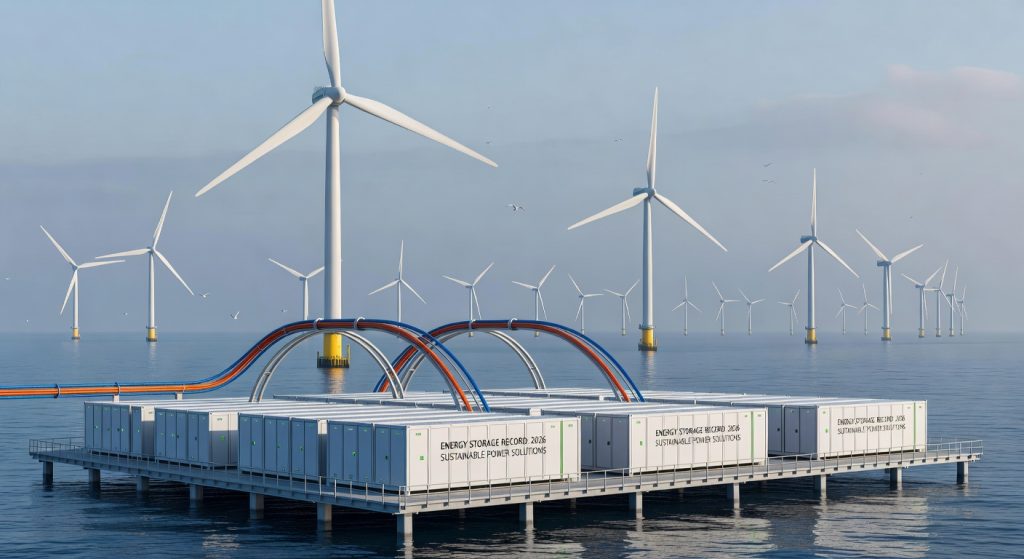
The first months of 2026 are delivering a cascade of milestones that suggest the global energy transition is moving faster than many analysts predicted. From completed offshore wind farms on the US Atlantic coast to a record surge in long-duration energy storage, the data points to a structural shift — not just an incremental improvement. For Europe, watching these developments unfold while navigating its own geopolitical pressures, the signals carry both inspiration and urgency.
Offshore Wind Reaches New Heights — and Europe Is Taking Notes
Two landmark projects have recently crossed critical thresholds in the United States. Vineyard Wind 1, an 800 MW offshore wind farm off the coast of Massachusetts, has completed turbine installation, while Revolution Wind (704 MW) in Rhode Island has delivered its first power to the grid. Together, these projects represent over 1.5 GW of clean electricity capacity coming online — enough to power hundreds of thousands of homes.
For European observers, the significance is twofold. First, it confirms that large-scale offshore wind deployment is technically and logistically achievable at speed, even in markets that started later than Europe. Second, the UK Government’s decision to remove import tariffs on offshore wind components starting April 1 offers a direct policy lesson: reducing cost barriers on supply chains can meaningfully accelerate deployment timelines. As EU member states continue to debate industrial policy and energy sovereignty, this kind of targeted tariff relief deserves serious attention from Brussels and national capitals alike.
Germany’s environment minister has already drawn the connection explicitly, urging accelerated renewable energy adoption as a strategic response to energy security concerns — a framing that resonates across a continent still recalibrating its energy mix in the wake of successive geopolitical shocks. Renewable energy is no longer framed solely as a climate solution; it is increasingly understood as infrastructure for national resilience.
Energy Storage: The Missing Piece Is Finally Arriving at Scale
Perhaps the most consequential figure from recent weeks is this: long-duration energy storage installations exceeded 15 GWh globally in 2025, representing a 49% year-on-year increase. This is not a marginal improvement — it is a step change in the infrastructure that makes high shares of variable renewable energy viable on the grid.
Long-duration storage — systems capable of storing energy for four hours or more — has long been identified as a critical bottleneck in the clean energy transition. Wind and solar generate power when conditions allow, not necessarily when demand peaks. Storage bridges that gap. The 49% growth rate suggests that manufacturing scale, falling costs, and supportive policy are finally converging.
In Europe, where grid flexibility is a growing priority, this trend has direct implications for resource management and energy efficiency. Countries like Germany, Italy, and Spain — which are rapidly expanding solar capacity — need storage solutions to avoid curtailment and maximise the value of every kilowatt-hour generated. The global storage surge provides both a market signal and a technology roadmap.
Solar’s Dominant Role and the Hydrogen Horizon
Zooming out to the full-year picture, 2026 is on track to be a record year for clean power deployment. In the US alone, 43.4 GW of solar capacity is expected to be added — with solar accounting for 51% of all new power generation capacity. Battery storage additions are forecast at 24 GW, underscoring the integrated nature of modern clean energy buildout.
These numbers matter for Europe not because they are European, but because they shape global supply chains, technology costs, and investment flows. As solar panels and battery cells become cheaper through scale, European projects benefit. And as green hydrogen infrastructure begins to mature — relying on cheap, abundant renewable electricity as its feedstock — the economics improve alongside it.
- Solar is now the dominant source of new power capacity globally
- Long-duration storage is scaling faster than most forecasts anticipated
- Offshore wind is proving its industrial maturity on both sides of the Atlantic
- Policy tools — like tariff relief and permitting reform — are making a measurable difference
What This Means for Europe’s Energy Future
The convergence of these trends — mature offshore wind, exponential storage growth, and solar dominance — creates a window of opportunity that European policymakers cannot afford to miss. The continent has the industrial base, the regulatory frameworks, and the political will. What it needs now is speed.
Lessons from the UK’s tariff decision and Germany’s renewed urgency suggest that energy security and climate ambition are no longer in tension — they are the same objective. Whether the focus is on water-efficient cooling systems for data centres, smarter resource management in manufacturing, or grid-scale storage for renewable integration, the direction of travel is clear.
Key takeaway: The energy transition is not approaching — it is already underway, faster and more broadly than the headlines often suggest. For Europe, the task is not to wait and watch, but to accelerate, adapt, and lead.