Green Tech at a Crossroads: How Geopolitics Is Reshaping Europe’s Clean Energy Future
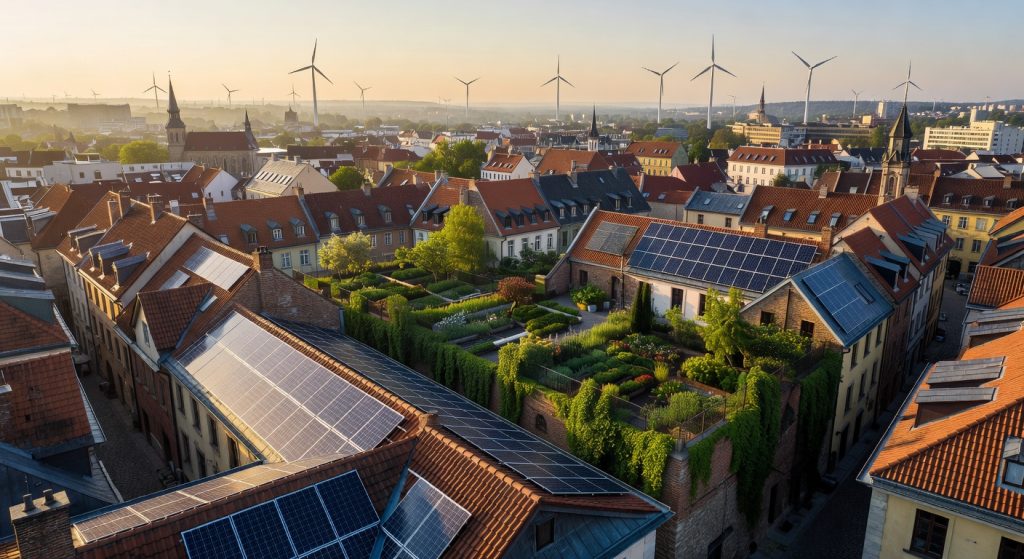
Global investment in green technology hit a record $2.3 trillion in 2025, with the European Union alone surging 18% to $455 billion. Electrified transport absorbed the largest share — $893 billion — driven by growth across Asia and Europe. By every financial metric, the energy transition is accelerating. And yet, a quieter, more complex force is beginning to shape how — and how fast — that transition actually unfolds: geopolitics.
New research published in March 2026 reveals a growing tension at the heart of European and North American cleantech strategy. Policymakers are increasingly reluctant to depend on Chinese manufacturers for critical green innovation components — solar panels, EV batteries, and renewable energy systems — even when those products are cheaper, more efficient, and more readily available. The consequences of that reluctance are real, and they ripple outward to businesses, households, and the climate itself.
The China Dilemma: Strategic Autonomy vs. Climate Urgency
China currently dominates global supply chains for many of the technologies that underpin the clean energy economy. From photovoltaic cells to lithium-ion battery packs, Chinese manufacturers have achieved scale, efficiency, and price points that competitors in Europe and North America are still working to match. This dominance is not accidental — it is the result of decades of industrial policy, subsidies, and infrastructure investment.
For European policymakers, this creates a genuine dilemma. Relying on Chinese supply chains for green technology raises legitimate concerns about strategic vulnerability, especially in a geopolitically volatile decade. The EU’s push for domestic manufacturing — through instruments like the Net-Zero Industry Act — reflects a desire for resilience and sovereignty. But the research published this March is clear: these protective instincts come at a cost. Slowing the adoption of already-available, cost-effective cleantech delays emissions reductions and raises prices for both businesses and citizens.
The tension is not theoretical. A European solar installer choosing between a high-efficiency Chinese module and a domestically produced alternative may face a significant price gap — one that affects project economics, consumer uptake, and ultimately, the pace of rooftop solar deployment across the continent.
High-Efficiency Solar and AI: Where Innovation Is Moving Fast
Even amid supply chain politics, green innovation continues to push forward at pace. On March 11, 2026, AIKO launched its third-generation ABC 60-Cell solar module in Australia — currently the world’s highest-efficiency mass-produced solar technology. Designed for rooftop applications, it points toward a future of decentralised energy access that could transform how households and small businesses participate in the energy transition.
Meanwhile, Huawei unveiled AI-powered Green Site and gigawatt-level AI Data Centre solutions at MWC Barcelona 2026, targeting smart energy infrastructure and digital power management. AI-driven tools are increasingly central to grid management, energy storage optimisation, and the cooling systems that keep data centres — themselves major energy consumers — running efficiently. These developments underscore a broader trend: artificial intelligence is becoming inseparable from cleantech, enabling smarter, more adaptive energy systems at scale.
The Green Materials Conference 2026, held in Vienna from March 16–18, added another dimension to this picture, showcasing European advances in sustainable polymers, ceramics, and nanomaterials — the building blocks of lighter, more energy-efficient structures and manufacturing processes. Europe’s strength in materials science may prove to be a meaningful differentiator in the global cleantech race.
Implications for Europe’s Energy and Industrial Strategy
For European decision-makers, the path forward requires holding two ideas simultaneously: strategic autonomy is legitimate, and climate urgency is non-negotiable. Policies that slow green tech adoption in the name of supply chain security must be weighed honestly against their climate and economic costs.
- Citizens will pay more for energy and electric mobility if domestic alternatives remain uncompetitive.
- Businesses face higher input costs and slower decarbonisation timelines.
- Smart cities projects dependent on affordable solar and storage may stall or scale back.
- Climate targets — already under pressure — become harder to meet when cost-effective solutions are deliberately sidelined.
A pragmatic approach might involve targeted domestic investment in the technologies where European competitiveness is achievable, while maintaining open trade channels for components where Chinese supply currently has no near-term substitute. Blanket protectionism is a luxury the climate cannot afford.
Key takeaway: Record cleantech investment signals genuine momentum, but geopolitical caution risks becoming a self-imposed brake on Europe’s energy transition. The smartest industrial strategy is one that builds resilience without sacrificing speed — because on climate, timing is everything.