Green Tech in 2025: How Low-Carbon Construction, Carbon Capture, and Electric Mobility Are Reshaping Europe’s Future
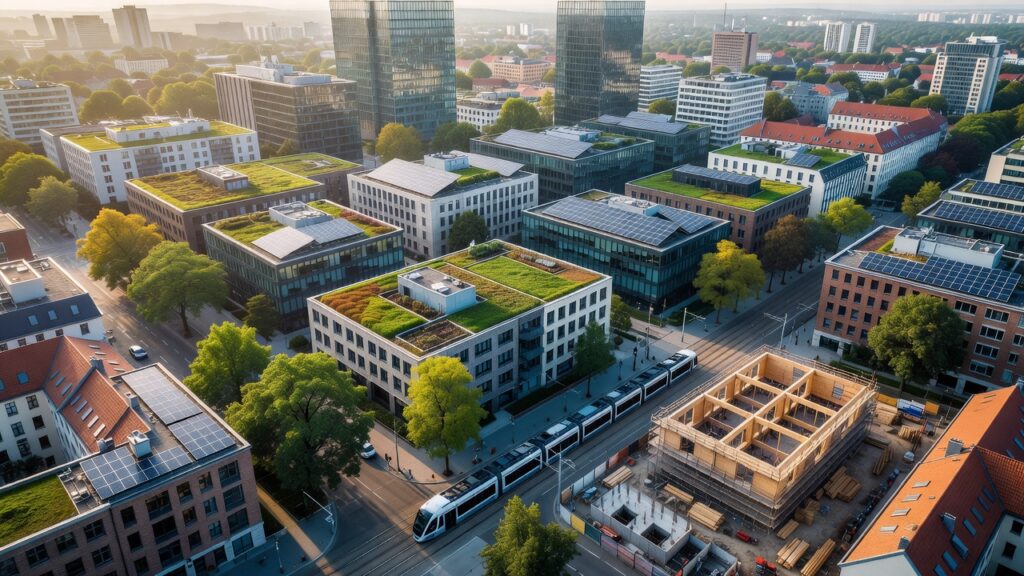
Europe’s green technology sector is no longer a niche conversation held in research labs and policy corridors. It has moved to construction sites, city streets, and industrial plants — and the pace of change is accelerating. Across low-carbon buildings, carbon capture systems, and electric mobility infrastructure, a new generation of cleantech solutions is beginning to deliver measurable results. Understanding these trends is essential for citizens, businesses, and policymakers navigating the energy transition.
Building Differently: The Rise of Low-Carbon Construction
The construction sector accounts for roughly 37% of global energy-related CO₂ emissions, according to the International Energy Agency — making it one of the most urgent targets for green innovation. The good news is that the industry is responding with a wave of new materials and design approaches that are fundamentally changing what it means to build sustainably.
Among the most promising developments is CO₂-injected concrete, a technology that permanently mineralises captured carbon dioxide into the concrete mix, reducing the material’s carbon footprint while maintaining structural integrity. Companies like CarbonCure Technologies have already demonstrated this at commercial scale in North America, and European manufacturers are following suit. Alongside this, carbon-negative materials — including mass timber, hempcrete, and bio-based insulation — are gaining traction as architects and developers seek to reduce whole-lifecycle emissions, not just operational energy use.
Smart buildings are also becoming a central pillar of green technology in the built environment. Integrated sensors, AI-driven energy management systems, and predictive heating and cooling controls can reduce a building’s energy consumption by up to 30%, according to estimates from the European Commission’s Renovation Wave initiative. For a continent where 75% of buildings are still considered energy-inefficient, the potential impact is enormous.
Capturing Carbon, Creating Value: CCUS Moves Toward the Mainstream
Carbon capture, utilisation, and storage — commonly known as CCUS — has long been viewed with scepticism by parts of the environmental community, often dismissed as a licence for polluters to continue business as usual. But a more nuanced picture is emerging. For hard-to-abate industries like cement, steel, and chemicals, CCUS is increasingly seen as a necessary complement to electrification and efficiency measures, not a substitute for them.
What is changing most rapidly is the economics. The cost of capturing one tonne of CO₂ from industrial sources has fallen significantly over the past decade, and the EU’s Innovation Fund has committed billions of euros to scaling up projects across member states. Crucially, the focus is shifting from mere storage to circular carbon use — converting captured CO₂ into synthetic fuels, chemical feedstocks, or building materials, creating new value chains in the process.
Norway’s Longship project, one of the world’s first full-scale carbon capture and storage operations, is already transporting CO₂ by ship for permanent geological storage beneath the North Sea — a model that other European nations are watching closely as they develop their own industrial decarbonisation strategies.
Moving Smarter: Electric Mobility and the Smart City Convergence
The electrification of transport remains one of the most visible fronts of the energy transition. Electric vehicle registrations in Europe reached a record share of new car sales in recent years, and the momentum is extending well beyond passenger cars. Electric ferries are now operating commercially in Scandinavia and the Baltic region, electric buses are replacing diesel fleets in cities from Amsterdam to Athens, and hydrogen-powered heavy trucks are beginning pilot programmes on major freight corridors.
What makes this moment particularly significant is the convergence of electric mobility with smart city infrastructure. AI-integrated sensors, 5G connectivity, and IoT platforms are enabling cities to manage traffic flow, reduce idle emissions, optimise charging networks, and cut urban energy waste in real time. Barcelona, Helsinki, and Amsterdam are among the European cities leading this integration, using data not just to improve efficiency but to actively support urban climate management goals.
What This Means for Europe — and the World
The convergence of these three trends — low-carbon construction, advanced carbon capture, and smart electric mobility — signals something important: green technology is no longer waiting for perfect conditions. It is being deployed, iterated, and scaled now, often driven by a combination of regulatory pressure from the EU Green Deal, rising carbon prices under the Emissions Trading System, and genuine market demand from consumers and investors alike.
For the rest of the world, Europe’s experience serves as both a model and a warning. The transition is possible, but it requires coordinated policy, sustained investment, and a willingness to accept that no single technology will solve everything.
Key takeaway: Green tech in 2025 is defined not by isolated breakthroughs but by the integration of multiple innovations — in materials, carbon management, mobility, and digital infrastructure — working together to reshape how Europe builds, moves, and powers itself. Staying informed about these developments is no longer optional for anyone with a stake in the future.