Green Technology in 2025: How Cleantech Is Reshaping Europe’s Cities and Energy Future
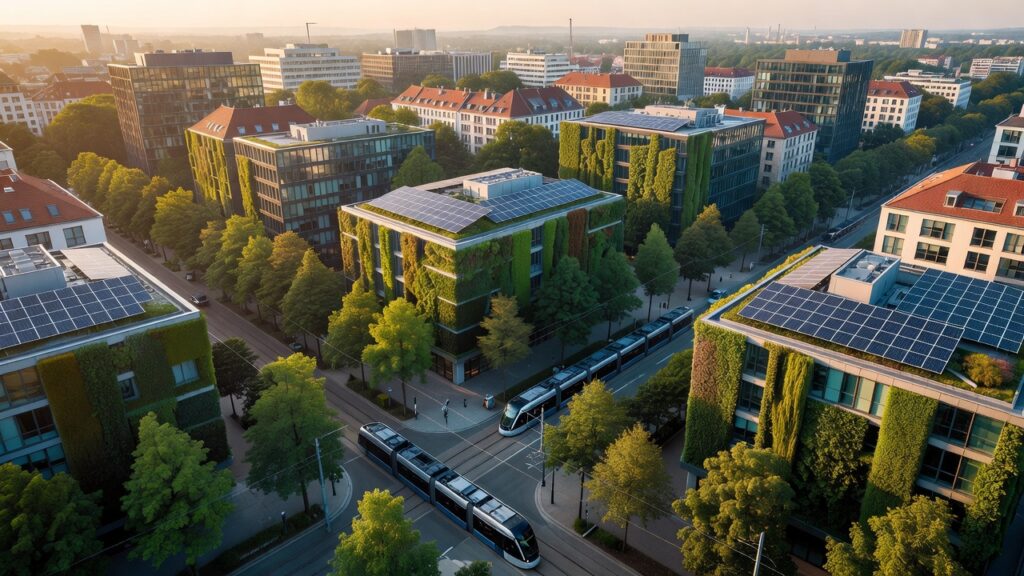
The pace of green technology development has rarely felt more urgent — or more promising. Across Europe and beyond, a new generation of cleantech solutions is moving from laboratory to landscape, quietly reshaping how we build our cities, power our homes, and move through the world. Understanding these shifts matters not just for engineers and policymakers, but for every citizen who will live inside the systems being designed today.
Carbon Capture, Smart Materials, and the New Frontier of Green Innovation
One of the most significant areas of green innovation right now sits at the intersection of chemistry and climate: carbon capture and conversion. Rather than simply storing captured CO₂ underground, researchers are increasingly focused on transforming it into something useful — fuels, building materials, or industrial feedstocks. This “carbon-to-value” approach could turn a waste problem into an economic opportunity, and European research institutions are among the global leaders in exploring it.
Equally important is the push toward biodegradable materials designed to reduce the mounting crisis of electronic waste. As the world produces an estimated 62 million tonnes of e-waste per year — a figure projected to grow by 82% by 2030 according to the UN Global E-waste Monitor — materials science is stepping up with components engineered to decompose safely. Advanced battery technologies, including solid-state and sodium-ion variants, are also attracting significant investment, promising safer, cheaper, and more sustainable energy storage for everything from smartphones to grid-scale infrastructure.
Perhaps less discussed but equally clever are emerging direct-air-capture approaches that exploit natural humidity gradients to extract moisture and energy from the atmosphere. These low-energy systems could prove transformative in water-stressed regions, including parts of Southern Europe already facing intensifying drought cycles.
Low-Carbon Buildings: The Emissions Lever We Cannot Ignore
Buildings account for approximately 40% of energy consumption and around 36% of CO₂ emissions in the European Union, making the construction and renovation sector one of the most critical battlegrounds of the energy transition. The EU’s revised Energy Performance of Buildings Directive (EPBD), adopted in 2024, sets a clear trajectory: all new buildings must be zero-emission by 2030, with a massive renovation wave required for existing stock.
This is driving rapid innovation in low-carbon construction materials — from mass timber and hempcrete to building-integrated photovoltaic (BIPV) panels that turn façades and rooftops into power generators. Smart cities are increasingly designing structures that don’t just consume less energy but actively produce it, feeding surplus electricity back into local grids. Cities like Amsterdam, Copenhagen, and Vienna are piloting districts where buildings, transport, and energy systems communicate in real time through IoT sensors, optimising consumption and cutting waste at a neighbourhood scale.
Electric Mobility and the Electrification of Urban Infrastructure
Electric mobility remains the most visible face of the cleantech revolution for most Europeans. EV registrations across the EU reached over 1.5 million units in 2023, and while growth has been uneven — with incentive policy playing a decisive role — the direction of travel is clear. Beyond private cars, the electrification wave is reaching public transport fleets, urban ferries, and last-mile logistics, areas where the emissions reductions per vehicle can be even more dramatic.
Hydrogen vehicles are also finding their niche, particularly for heavy transport — trucks, trains, and maritime vessels — where battery weight and range limitations make direct electrification harder. Europe’s hydrogen strategy, backed by the European Hydrogen Bank, aims to produce 10 million tonnes of renewable hydrogen domestically by 2030, a target that will require both political will and continued green technology investment at scale.
What This Means for Europe’s Green Future
The convergence of carbon capture, smart construction, and electric mobility signals something important: the energy transition is no longer a single-sector story. It is a systemic redesign of how cities function, how materials are made, and how people move. For European citizens, this means cleaner air, lower energy bills over time, and cities that are more resilient to climate shocks. For businesses and investors, it means a rapidly expanding market for solutions that work.
- Carbon-to-value technologies could create new industrial value chains across Europe.
- Building renovation under the EPBD represents one of the largest investment opportunities of the decade.
- Electric mobility ecosystems — charging, grid integration, fleet management — are generating thousands of new jobs.
- Smart city platforms are turning environmental data into actionable policy in real time.
Key takeaway: Green technology in 2025 is not a niche concern — it is the infrastructure of tomorrow’s economy. Europe has the regulatory framework, the research talent, and increasingly the industrial capacity to lead this transition. The challenge now is speed: translating innovation into deployment, and ambition into action, before the window for meaningful climate impact narrows further.