Hydrogen Breakthroughs and the EU’s 90% Climate Target: How Green Tech Is Reshaping Europe’s Energy Future
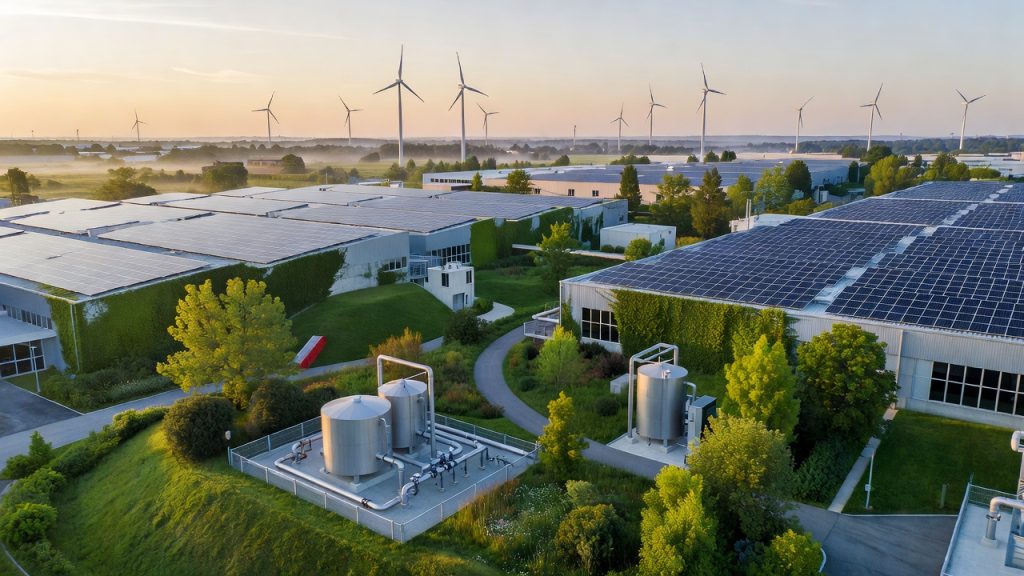
Europe’s energy transition just received two powerful signals in the same week: the European Union formally approved a 90% greenhouse gas emissions reduction target by 2040, and researchers at the University of Birmingham announced a promising breakthrough in low-temperature hydrogen production. Together, these developments paint a picture of a continent pushing hard on both policy ambition and technological innovation — even as regulatory trade-offs complicate the path forward.
The EU’s 2040 Climate Target: A Long-Term Signal for Green Investment
The final approval of the EU’s 90% emissions-cut target for 2040 is more than a political milestone — it is a regulatory compass for industries, investors, and cities across the continent. By locking in one of the most ambitious intermediate climate goals in the world, the EU is sending an unambiguous message to sectors ranging from clean energy and industrial decarbonization to transport electrification and smart cities development: the direction of travel is set, and it is steep.
For green technology companies and cleantech investors, this matters enormously. Long-term regulatory certainty is often the single most important factor in unlocking large-scale capital deployment. Projects in electric mobility infrastructure, grid modernization, and industrial process innovation now have a clearer compliance horizon to plan against. The target also reinforces Europe’s position as a global standard-setter, influencing supply chain decisions and technology partnerships well beyond its borders.
There is, however, a notable tension. In the same legislative cycle, EU countries approved a scaling back of supply-chain due diligence rules on environmental and human-rights risks — a move that eases compliance pressure for some businesses but raises questions about the coherence of Europe’s ESG policy framework. For cross-border companies and sustainability professionals, the message is mixed: ambition at the macro level, pragmatism at the operational level.
A Hydrogen Breakthrough That Could Change the Cost Equation
On the innovation front, scientists at the University of Birmingham have developed a perovskite-based catalyst capable of producing hydrogen at significantly lower temperatures than conventional methods. This is a potentially transformative development for the green innovation ecosystem.
Today, most clean hydrogen production — particularly green hydrogen via electrolysis — requires substantial energy input and expensive infrastructure. A lower-temperature production pathway could dramatically reduce both the energy cost and the capital expenditure associated with hydrogen generation, making it more competitive with fossil-fuel alternatives and accelerating its role in hard-to-abate sectors like steel, shipping, and heavy industry.
The caveat, as always with laboratory breakthroughs, is scale. Moving from a controlled research environment to industrial deployment involves years of engineering, investment, and regulatory navigation. But within the context of the EU’s 2040 target and the broader European Hydrogen Strategy, this kind of green tech innovation is exactly what policymakers are counting on to bridge the gap between ambition and achievability.
Global Context: China, India, and the Cleantech Supply Chain
Europe’s green technology agenda does not exist in isolation. Two developments from Asia add important global context:
- China has announced plans to reduce its carbon intensity by 17% under its current five-year plan — an acceleration compared to the previous cycle. For European cleantech companies, this signals both competitive pressure and potential opportunity, particularly in solar manufacturing, battery technology, and electric mobility components.
- India has confirmed it will not extend the ALMM List-II compliance deadline beyond June 1, 2026, tightening rules on solar equipment sourcing. This affects project timelines and supply chain strategies for companies operating in or sourcing from the Indian solar market — a dynamic that European developers and equipment suppliers should monitor closely.
These shifts underscore that the energy transition is a globally interconnected process, where policy decisions in Beijing or New Delhi ripple through European investment strategies and green technology supply chains.
Implications for Citizens, Businesses, and Decision-Makers
For ordinary citizens, the EU’s 2040 target translates into a future of cleaner air, lower-emission transport, and more energy-efficient buildings — but also a transition that will require investment, adaptation, and political will to manage fairly. For businesses, the combination of tighter climate targets and evolving due diligence rules demands strategic agility. And for decision-makers, the hydrogen breakthrough is a reminder that public investment in research and development remains a critical lever for making the energy transition both credible and cost-effective.
Key takeaway: The convergence of a landmark EU climate target and a promising green tech innovation moment creates a rare alignment of policy direction and technological possibility. The challenge now is to translate both into real-world deployment — at speed, at scale, and with equity.