Europe Bets on Battery Storage as Renewable Energy Hits Record Growth
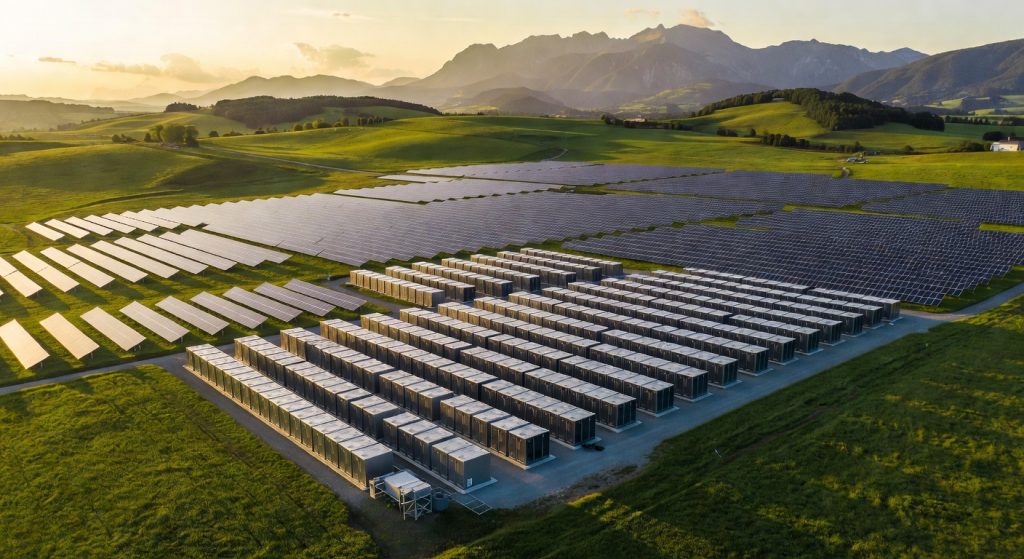
The global energy transition is no longer a distant ambition — it is a construction site. With the International Energy Agency (IEA) projecting nearly 935 GW of new renewable energy capacity per year by 2030, up from 666 GW in 2024, the race to build, store, and distribute clean power is reshaping industrial policy on both sides of the Atlantic. At the heart of this shift, Europe is making a pointed strategic choice: secure its own clean-tech supply chain before it falls further behind.
The EU Backs a Bulgarian Battery Project — and Signals a Broader Strategy
In a move that went largely unnoticed outside energy policy circles, the European Union recently awarded strategic project status under the Net-Zero Industry Act (NZIA) to Exeron (X-BESS), a fully integrated battery energy storage system developed by International Power Supply in Bulgaria. It is exactly the kind of decision the NZIA was designed to enable: fast-tracking permitting, cutting red tape, and channelling institutional support toward domestic manufacturing of net-zero technologies.
Why does this matter? Because solar and wind are expected to account for 95% of all new renewable capacity additions between now and 2030, according to the IEA. Both are inherently intermittent. Without large-scale, domestically produced storage solutions, Europe risks building an impressive renewable fleet that cannot reliably deliver power when the sun sets or the wind drops. Battery storage is not a complement to the energy transition — it is a prerequisite.
The NZIA framework, modelled in part as a European response to the U.S. Inflation Reduction Act, aims to ensure that at least 40% of the EU’s clean technology needs are manufactured within its own borders by 2030. The Exeron project is an early, concrete example of that policy translating into industrial reality — and Bulgaria, often overlooked in green economy conversations, is now part of that story.
A Global Surge in Solar and Wind — With Storage Leading the Next Wave
The IEA’s latest projections paint a striking picture of where renewable energy is headed. More than 5,520 GW of renewable capacity is expected to be added globally between 2024 and 2030. Offshore wind alone is on track to reach 212 GW by 2030, driving sustained demand for turbines, undersea cables, transmission infrastructure, and — crucially — grid-scale storage.
Across the Atlantic, the United States added 55.9 GW of solar, wind, and storage in 2025, with battery deployments growing an impressive 39% year over year. Wind and solar now supply 17% of utility-scale electricity in the U.S., with renewables overall reaching 24% of the generation mix. These figures are significant not just for American consumers — who are seeing more affordable and reliable power options — but for European policymakers watching how rapidly a large, complex grid can decarbonise when the right incentives are in place.
The solar-plus-storage combination is emerging as the dominant innovation pathway. Falling costs for both photovoltaic panels and lithium-ion batteries are making this pairing increasingly competitive with fossil fuel peaker plants, improving both energy efficiency and resource management at grid level.
What This Means for Europe’s Energy Security and Industrial Future
For European citizens, professionals, and decision-makers, the implications are layered:
- Grid reliability: More storage means fewer blackouts, better integration of rooftop solar, and a smoother transition away from gas peaking plants.
- Industrial competitiveness: Strategic projects like Exeron signal that Europe is serious about not outsourcing its clean-tech manufacturing to Asia or the U.S.
- Energy security: Domestic battery production reduces dependence on imported components, strengthening Europe’s position in a world where clean energy supply chains are becoming geopolitical leverage.
- Green hydrogen potential: As storage and renewable energy capacity scales, surplus electricity can increasingly feed electrolysers, making hydrogen production more viable and cost-effective.
Water and land-use considerations also come into play as projects scale up — responsible resource management will be essential to ensure that the renewable buildout does not create new environmental pressures even as it resolves old ones.
Key Takeaway
The EU’s decision to fast-track the Bulgarian battery storage project is a small but telling data point in a much larger story: the energy transition is accelerating, and the countries and regions that invest now in manufacturing, storage, and grid flexibility will be best positioned to lead — economically and strategically — in the decades ahead. With nearly a terawatt of new renewable energy coming online annually by the end of this decade, the question is no longer whether the transition will happen. It is who will build the infrastructure that makes it work.