Beyond Solar Panels and Wind Turbines: Why Grids and Storage Are Now the Real Bottleneck for the Energy Transition
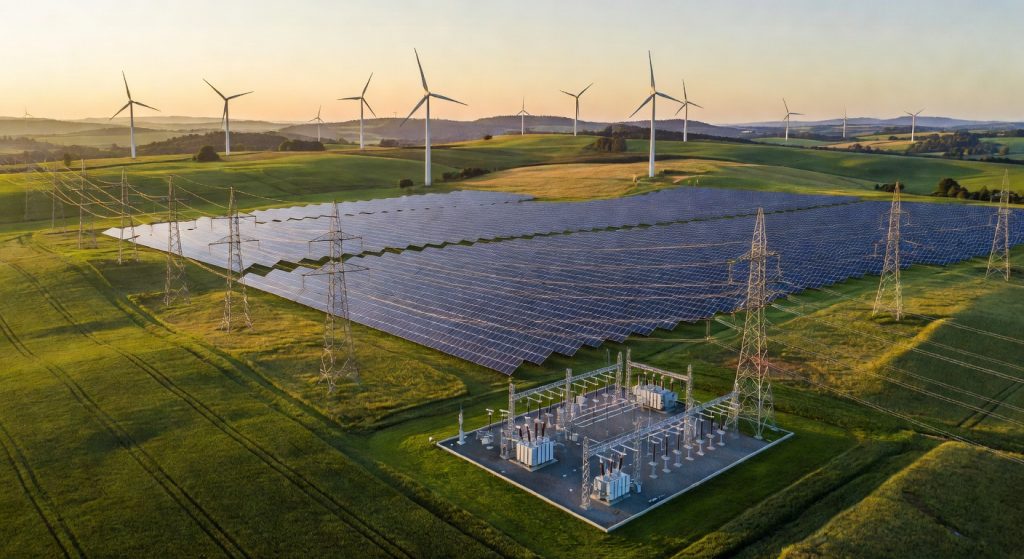
For years, the central challenge of the energy transition was making clean energy cheap enough to compete with fossil fuels. That battle has largely been won. Solar and wind are now the cheapest sources of new electricity generation in most of the world. Yet a new, less glamorous problem is emerging — and it is slowing everything down. The bottleneck has shifted from green technology itself to the infrastructure and policy frameworks needed to make it work at scale.
China’s Renewables Paradox: Building Fast, Wasting More
Nowhere is this tension more visible than in China. The country has shattered records for wind and solar installations year after year, cementing its role as the world’s dominant force in cleantech manufacturing and deployment. Yet, as Bloomberg Green reports, this breakneck expansion is running into a stubborn wall: transmission infrastructure and grid balancing systems are simply not keeping pace.
The result is curtailment — renewable energy that is generated but cannot be delivered to consumers, and is therefore wasted. In some Chinese regions, wind and solar curtailment rates have climbed back toward levels not seen since the mid-2010s, eroding the economic and environmental returns of billions of euros in clean-energy investment. The lesson is stark: you can build as many solar panels and wind turbines as you like, but without the grid to carry the electricity and the storage to balance supply and demand, much of that investment delivers diminished returns.
This is not a uniquely Chinese problem. It is a global signal. Green innovation in generation technology has outpaced innovation in the systems that support it.
Storage and Grid Investment: The New Frontier of Clean Energy
The solution is increasingly clear, even if the implementation remains complex and costly. Grid-scale battery storage is emerging as one of the most critical tools for stabilising renewables-heavy electricity systems. A landmark example arrived recently in Australia, where a A$1 billion (roughly €600 million) battery project backed by BlackRock has been activated — described as one of the most powerful grid-scale storage installations in the world. The facility is designed to absorb excess renewable generation and release it when demand peaks, smoothing out the inherent variability of wind and solar.
For Europe, the implications are direct. The continent is aggressively scaling up renewables as part of its REPowerEU strategy, but grid upgrade timelines remain a persistent concern. Permitting bottlenecks, cross-border interconnection gaps, and underinvestment in distribution networks risk creating European versions of the same curtailment problem China is experiencing. Smart cities and industrial zones increasingly dependent on clean electricity — including the growing ecosystem of electric mobility infrastructure — cannot function reliably without grids capable of handling two-way, variable power flows.
Meanwhile, research is pushing the boundaries of what is technically possible. A pilot-scale process reported by TechXplore is now converting CO₂ directly into synthetic gasoline at a rate of 50 kg per day — a potential breakthrough for hard-to-abate sectors where electrification alone is insufficient. Advances in lower-energy computing and next-generation magnets (critical for wind turbines and electric motors) are also moving from laboratory to demonstration phase, reinforcing that green innovation continues across the full technology stack.
Policy Certainty: The Invisible Infrastructure
Technology and physical infrastructure are only part of the equation. Policy stability has become equally decisive. In India, a regulator in the country’s leading solar state has again blocked a 3.2 GW coal power project, according to Reuters — a sign that regional governance can either accelerate or derail the energy transition depending on local political dynamics. In the United States, pressure on clean-energy tax incentives following recent legislative changes is creating uncertainty for project developers and supply chains alike.
Europe is not immune. Ongoing debates around green hydrogen standards, green steel subsidies, and critical minerals sourcing reflect the reality that cleantech investment decisions are now as sensitive to regulatory frameworks as they are to technology costs. For businesses planning long-term capital allocation, policy unpredictability is itself a form of infrastructure failure.
What This Means for Citizens, Businesses, and Decision-Makers
- For citizens: Grid bottlenecks and policy delays translate directly into slower emissions reductions and postponed savings on energy bills. Advocacy for faster grid permitting and storage investment is as important as support for new renewables.
- For businesses: Project economics in the clean-energy sector now depend heavily on grid access, storage availability, and policy continuity — not just the cost of panels or turbines. Supply chain strategies must account for these systemic risks.
- For decision-makers: The priority must shift toward enabling infrastructure — transmission upgrades, storage deployment, streamlined permitting — alongside continued support for green technology innovation and industrial decarbonization pilots.
Key takeaway: The energy transition has entered a new phase. The core challenge is no longer making clean energy cheap — it already is. The challenge now is building the grids, storage systems, and policy frameworks fast enough to let that cheap, clean energy actually reach the people and industries that need it. Europe has both the ambition and the tools to lead on this. The question is whether decision-makers will move with the urgency the moment demands.