U.S. Climate Policy in Freefall: What Record Heat, Endangered Penguins, and Rising Seas Mean for the World
In the span of just a few weeks, the signals from across the Atlantic have grown impossible to ignore. The United States — historically one of the world’s largest greenhouse gas emitters — is simultaneously experiencing its most extreme climate events on record while its federal government systematically dismantles the legal and scientific infrastructure designed to address them. For European citizens, policymakers, and businesses already navigating the EU’s ambitious Green Deal agenda, this divergence carries profound consequences.
A Legal Foundation Crumbles: The EPA’s Endangerment Finding Under Attack
At the center of the current storm is the U.S. Environmental Protection Agency’s decision to repeal the so-called Endangerment Finding — the 2009 legal determination that greenhouse gases threaten public health and welfare. This finding has served as the cornerstone of virtually every major federal climate regulation in the United States for over fifteen years, from vehicle emissions standards to power plant pollution limits.
EPA Administrator Lee Zeldin defended the repeal before Congress, framing it as a correction of regulatory overreach. Critics — including former EPA officials, climate scientists, and legal scholars — describe it as a deliberate demolition of the country’s environmental policy architecture. The Trump administration has also moved to shut down a leading climate research institution in Boulder, Colorado, accusing its scientists of promoting “climate alarmism.” The closure threatens decades of atmospheric data collection and modelling capacity that researchers worldwide, including in Europe, rely upon.
From a European perspective, this is not merely a domestic American affair. U.S. withdrawal from multilateral climate commitments and the erosion of its scientific institutions weakens the global evidence base and reduces pressure on other major emitters — particularly in Asia — to accelerate their own transitions.
The Climate Is Not Waiting: Records Shattered, Species Lost, Coastlines Redrawn
While Washington debates legal definitions, the physical climate system is delivering unambiguous answers. March 2026 was the hottest March ever recorded for the contiguous United States, surpassing previous records by the largest margin ever documented. Meteorologists warn that an emerging El Niño pattern could push global average temperatures even higher through the remainder of 2026 — a deeply concerning prospect given that the past two years already rank among the warmest in recorded human history.
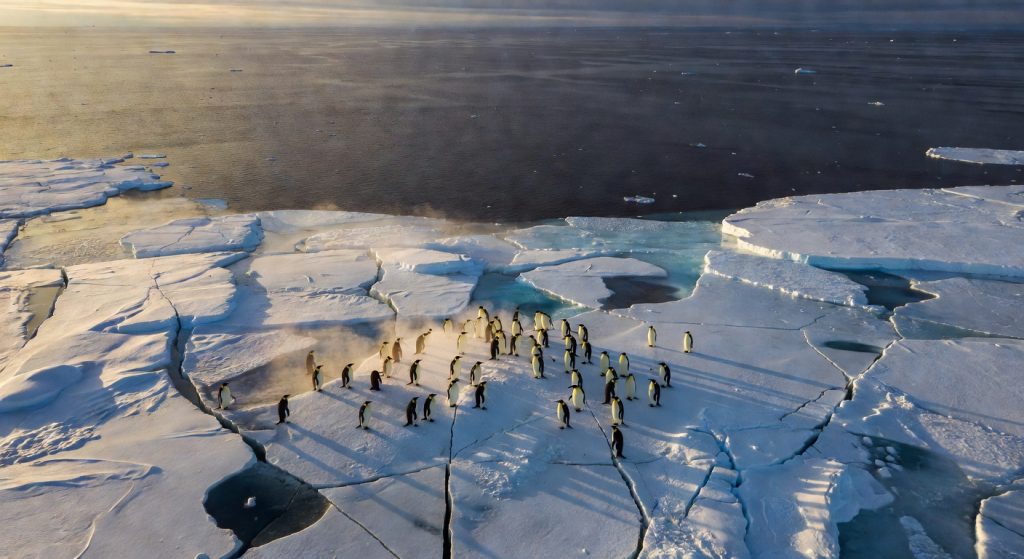
The biodiversity crisis is accelerating in parallel. Emperor penguins have been officially declared an endangered species, a milestone that underscores how rapidly climate change is reshaping Antarctic ecosystems. Sea ice loss — the foundation of the emperor penguin’s breeding cycle — has reached critical levels, with some colonies recording near-total breeding failure in recent seasons. The listing is a stark reminder that conservation and climate action are inseparable: you cannot protect species without stabilising the climate systems they depend on.
Adding urgency to coastal planning worldwide, new sea level rise research suggests that water heights along many coastlines may have been underestimated by an average of one foot (approximately 30 centimetres). For low-lying European cities — from Amsterdam to Venice, from Hamburg to Thessaloniki — this data revision demands immediate reassessment of flood defence investments and urban planning frameworks. Meanwhile, severe snow drought across the western United States is already straining freshwater reserves and complicating wildfire season preparedness, a preview of the water scarcity challenges that Mediterranean Europe increasingly faces each summer.
Implications for Europe: Opportunity, Risk, and Responsibility
The U.S. policy rollback creates a complex landscape for Europe. On one hand, it opens a window of competitive advantage: European industries investing in renewable energy, clean technology, and sustainable supply chains are positioning themselves in markets that American competitors may abandon. The EU’s Carbon Border Adjustment Mechanism (CBAM) also gains new relevance as a tool to ensure that imports from countries without credible environmental policy do not undercut European producers who bear the cost of compliance.
On the other hand, the risks are real. A weakened global climate governance framework makes it harder to achieve the emissions reductions that science demands. Europe cannot decarbonise the planet alone. And the revised sea level data, combined with accelerating extreme weather, means that adaptation costs — for infrastructure, agriculture, insurance, and public health — will rise regardless of what any single government decides.
- Coastal cities must urgently update flood risk models using the latest sea level projections.
- Policymakers should reinforce EU support for international climate science networks to compensate for U.S. institutional losses.
- Businesses operating in transatlantic markets need scenario planning that accounts for deepening U.S. regulatory divergence.
- Citizens can support credible conservation and climate organisations filling the gaps left by retreating public institutions.
Key takeaway: The acceleration of climate impacts and the simultaneous retreat of U.S. climate governance are not contradictory trends — they are a dangerous feedback loop. Europe has both the tools and the responsibility to hold the line on ambition, invest in resilience, and keep the global conversation grounded in science rather than politics.