Green Tech in 2025: Hydrogen, Battery Recycling, and Smart Cities Are Reshaping the Energy Transition
The pace of green innovation is not slowing down — if anything, it is accelerating in unexpected places and ways. Even as federal climate policy in the United States faces significant rollbacks, state-level initiatives, university laboratories, and international research teams are pushing green technology forward with tangible, scalable results. For European citizens, professionals, and policymakers watching the global energy transition, the signals are both encouraging and instructive.
Green Hydrogen Takes Root — Even Against the Political Wind
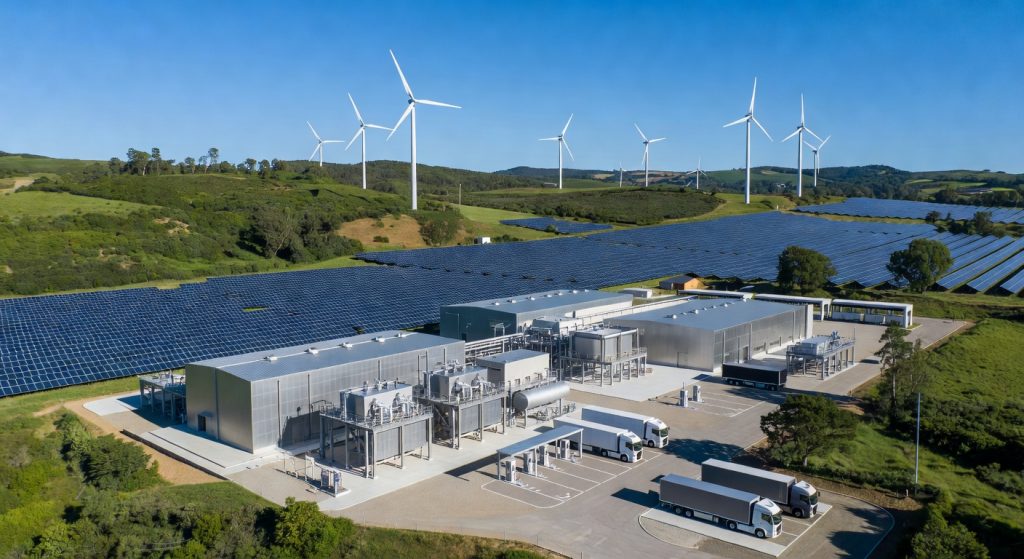
One of the most telling stories of this moment comes from California, where the Avina Clean Hydrogen Facility is advancing despite a hostile federal environment. Supported by state grants, the facility is set to produce up to 4 metric tons of green hydrogen per day, supplying fuel-cell trucks and buses across the region. The projected impact is substantial: an estimated 130,000 metric tons of CO₂ avoided annually — equivalent to taking roughly 28,000 cars off the road.
This development carries a clear lesson for Europe, where the EU Hydrogen Strategy aims to install at least 40 GW of renewable hydrogen electrolysers by 2030. The California model demonstrates that sub-national actors — regions, municipalities, and states — can drive cleantech deployment even when central governments hesitate. In a continent where regional policy often shapes implementation, this is a model worth studying closely.
Battery Recycling and Waste-to-Fuel: Science Closes the Loop
Two research breakthroughs are quietly redefining what the circular economy can look like in practice. At Rice University, scientists have developed a faster, more energy-efficient method to recover critical minerals — including lithium, cobalt, and nickel — from spent lithium-ion batteries. As demand for electric mobility surges across Europe and beyond, supply chain pressure on these materials is becoming a strategic vulnerability. Improved recycling technology directly addresses that bottleneck, reducing dependence on primary mining and the geopolitical risks it entails.
Separately, researchers are advancing sunlight-driven processes that transform waste plastics into usable fuels. This dual-purpose innovation tackles two of the most pressing environmental challenges simultaneously: plastic pollution and clean energy scarcity. For European industries navigating both the EU Plastics Strategy and rising energy costs, such technologies represent a genuinely promising convergence.
- Critical mineral recovery from spent EV batteries reduces supply chain risk for European automakers
- Photocatalytic plastic-to-fuel conversion addresses waste streams while generating energy value
- Both innovations support the EU’s broader circular economy action plan goals
IoT, AI, and the Rise of Smart Cities as Green Infrastructure
Beyond laboratories and industrial facilities, the integration of AI and IoT into everyday infrastructure is emerging as one of the most powerful levers for the energy transition. The IoT segment alone is projected to account for 26% of the global green tech market by 2026, enabling real-time monitoring of energy consumption, emissions, and resource flows for businesses and governments alike.
For smart cities — a priority investment area across the EU, from Amsterdam to Barcelona to Vienna — this means smarter grids, optimised public transport, and buildings that respond dynamically to energy demand. AI-driven energy optimisation is no longer a future concept; it is being deployed today to cut carbon footprints and improve urban resilience. The upcoming UN STI Forum on Science, Technology and Innovation for SDGs, scheduled for May 6–7, 2026, will focus precisely on scaling these solutions globally, offering a key moment for European actors to shape the international agenda.
What This Means for Europe
Taken together, these developments paint a picture of a green technology landscape that is maturing rapidly — driven not by a single actor, but by a distributed ecosystem of researchers, regional governments, and forward-looking industries. Europe is well-positioned to benefit, given its regulatory frameworks, research investment, and industrial base. However, the risk of falling behind in manufacturing and deployment — particularly in battery technology and hydrogen infrastructure — remains real.
The key takeaway is this: the energy transition is not waiting for perfect political conditions. From California to university campuses to smart city control rooms, green innovation is advancing on multiple fronts at once. For European decision-makers, the imperative is to match this momentum with coordinated investment, streamlined permitting, and genuine cross-border collaboration — before the window of competitive advantage narrows further.