Renewables Win in Court, Carbon Deals Surge: ESG Momentum Defies Political Headwinds
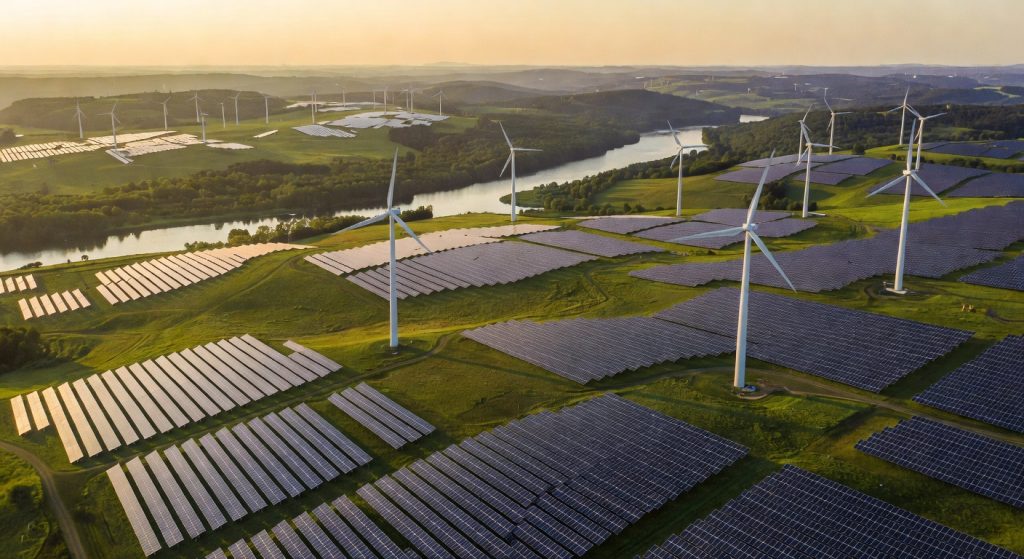
The global sustainability landscape rarely moves in a straight line — but this week delivered a cluster of signals that, taken together, paint a picture of a green economy increasingly capable of defending itself. From courtroom victories for wind and solar to landmark corporate carbon removal agreements, the ESG space is demonstrating a resilience that will resonate well beyond American borders.
A Legal Lifeline for Renewable Energy
In one of the most consequential rulings for clean energy in recent months, a US federal court issued a preliminary injunction blocking the Trump administration’s attempts to stifle wind and solar development. The decision protects approximately 57 gigawatts of renewable energy projects — enough to power tens of millions of homes — and safeguards an estimated $905 million in clean energy investment from bureaucratic paralysis.
For European observers, the ruling carries important lessons. The EU’s own renewable permitting bottlenecks have been a persistent obstacle to meeting 2030 climate targets, with the REPowerEU plan demanding accelerated deployment of wind and solar across member states. The American case underscores a broader truth: when political will wavers, legal frameworks and institutional checks can serve as a critical backstop for the energy transition. Courts, it turns out, are becoming an unlikely but vital arena for sustainability policy.
Corporate Carbon Removal: From Pledges to Contracts
Perhaps the most striking development this week is the acceleration of corporate carbon removal investments, signalling a maturation of sustainable finance from aspiration to contractual commitment.
- Microsoft reaffirmed its carbon removal programme — despite earlier pause reports — by signing a deal for 626,000 metric tons of bioenergy carbon dioxide removal (BECDR) with Canada’s first majority Indigenous-owned carbon project. The agreement is notable not only for its scale but for its integration of social equity into climate action, a model increasingly demanded by ESG frameworks.
- JPMorgan announced a 10-year agreement with Graphyte for 60,000 metric tons of biomass-based carbon removals — one of the longest-horizon carbon deals from a major financial institution to date. This kind of long-term commitment signals that carbon removal is transitioning from a niche offset market into a structured asset class within sustainable finance.
These deals matter for European companies navigating the Corporate Sustainability Reporting Directive (CSRD) and the incoming Carbon Removal Certification Framework (CRCF). As Brussels moves to standardise and legitimise carbon removal credits, American corporate leadership in this space sets a benchmark — and a competitive pressure — that European businesses cannot ignore.
Circular Economy and Waste Reduction Take Centre Stage
Beyond energy and carbon markets, two further developments reflect a broadening of the circular economy agenda. The US Environmental Protection Agency launched its ‘Feed It Onward’ initiative, targeting food waste reduction while simultaneously strengthening food security — a dual mandate that aligns closely with the EU’s Farm to Fork Strategy and its goal of halving food waste by 2030.
Meanwhile, Thrive Market launched a Climate Action Working Group engaging over 1,000 brands in measuring and reducing both carbon and plastic footprints. This kind of supply-chain-wide mobilisation mirrors what European regulators are pushing through the Ecodesign for Sustainable Products Regulation and extended producer responsibility schemes — but driven here by market demand rather than legislative mandate.
Together, these initiatives suggest that corporate responsibility is evolving from a reporting exercise into an operational priority, reshaping procurement, logistics, and product design across sectors.
Implications for European Businesses and Policymakers
The week’s developments offer a clear message for European stakeholders: the green business transition is accelerating on multiple fronts simultaneously, and the risk of being left behind is real. Companies that treat ESG as a compliance checkbox are increasingly out of step with peers who are locking in decade-long carbon contracts and restructuring supply chains around sustainability metrics.
For policymakers, the US court ruling is a reminder that robust legal protections for clean energy infrastructure are not a luxury — they are a strategic necessity in an era of political volatility.
Key takeaway: Whether through courtrooms, capital markets, or circular economy initiatives, the architecture of a sustainable economy is being built piece by piece — and the pace is quickening. For citizens, businesses, and decision-makers across Europe, now is the time to engage, invest, and advocate with urgency.