Green Tech in 2026: How Europe Is Accelerating the Clean Energy Transition
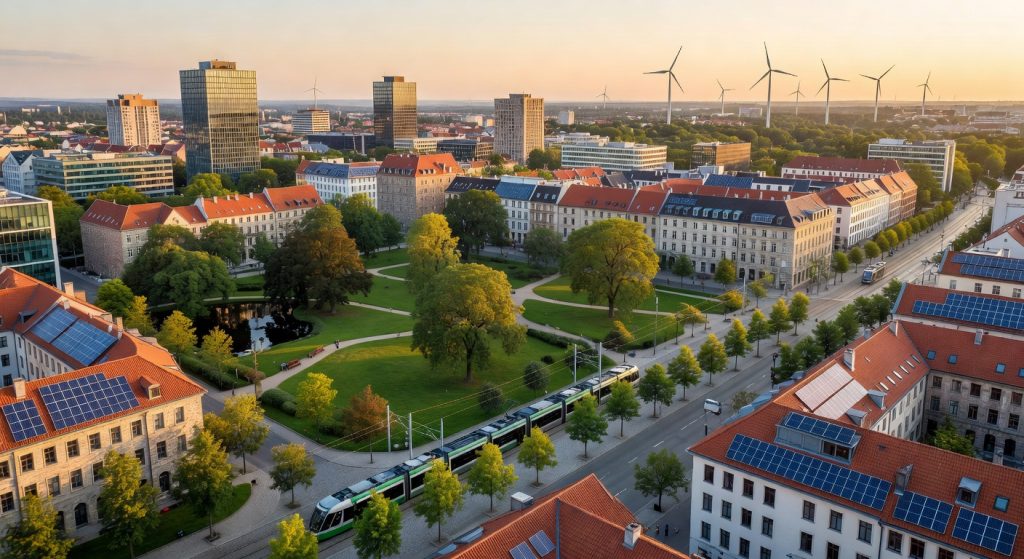
Europe is doubling down on its cleantech ambitions. Across the continent, governments, startups, and established industries are converging around a shared goal: building an economy that is not only carbon-neutral but genuinely regenerative. In 2026, green technology is no longer a niche sector — it is rapidly becoming the backbone of Europe’s industrial and urban future.
The Energy Transition Gains Momentum — But Challenges Remain
The energy transition is arguably the defining economic story of this decade. According to the International Energy Agency (IEA), renewable energy sources accounted for nearly 42% of global electricity generation in 2024, with Europe consistently outperforming global averages. The European Union’s REPowerEU plan has channelled hundreds of billions of euros into solar, wind, and grid modernisation, and the results are beginning to show.
Yet the transition is not without friction. Grid infrastructure in many member states still struggles to absorb the intermittent nature of renewables. Energy storage — particularly at grid scale — remains a bottleneck, and the race to deploy next-generation battery technologies, green hydrogen, and smart grid solutions is intensifying. Startups across Germany, Sweden, and the Netherlands are attracting record levels of cleantech investment, signalling that private capital sees long-term opportunity even amid short-term volatility.
- Solar capacity in the EU grew by over 65 GW in 2024 alone, a record annual addition.
- Green hydrogen projects are scaling up in Spain, Portugal, and the North Sea corridor.
- Battery storage installations in Europe tripled between 2022 and 2025, according to BloombergNEF.
Electric Mobility and Smart Cities: Urban Life Is Being Reinvented
Nowhere is green innovation more visible than in Europe’s cities. Electric mobility has crossed a critical threshold: in Norway, the Netherlands, and increasingly in Germany and France, electric vehicles now represent the majority of new car sales. But the transformation goes well beyond private cars. Electric buses, cargo bikes, shared micro-mobility platforms, and hydrogen-powered ferries are collectively rewriting the logic of urban transport.
Simultaneously, the concept of smart cities is maturing from a buzzword into operational reality. Cities like Amsterdam, Barcelona, and Helsinki are deploying sensor networks, AI-driven energy management systems, and digital twin technologies to optimise everything from street lighting to waste collection. The EU’s Horizon Europe programme has committed significant funding to smart city pilots, recognising that urban areas account for roughly 75% of the EU’s energy consumption and a comparable share of emissions.
The integration of electric mobility infrastructure with smart city platforms — for instance, using EV charging networks as distributed grid assets — represents one of the most promising frontiers in applied green technology today.
Policy and Investment: The Architecture of Change
Behind every technological breakthrough is a policy framework that either enables or constrains it. The EU’s Green Deal Industrial Plan, the Net-Zero Industry Act, and the revised Emissions Trading System (ETS) are collectively creating a regulatory environment designed to reward low-carbon innovation and penalise carbon-intensive incumbents. Carbon prices in Europe have remained elevated, providing a sustained economic signal for businesses to decarbonise.
Global competition is also shaping Europe’s strategy. The United States’ Inflation Reduction Act and China’s aggressive cleantech manufacturing subsidies have prompted Brussels to respond with its own industrial policy tools, aiming to ensure that Europe remains a cleantech leader rather than becoming a passive importer of green technologies developed elsewhere.
Implications for Citizens, Businesses, and Policymakers
The green technology revolution is not an abstract policy debate — it has concrete implications for daily life and economic opportunity. For citizens, it means cleaner air, lower long-term energy bills, and new forms of urban mobility. For businesses, it represents both disruption and opportunity: those who adapt early stand to gain competitive advantage, while those who delay face stranded assets and regulatory exposure. For policymakers, the challenge is to ensure that the transition is equitable — that the benefits of green innovation are broadly shared and that vulnerable communities are not left behind.
Key takeaway: Europe’s green technology ecosystem is maturing rapidly, driven by the convergence of ambitious policy, rising private investment, and genuine technological breakthroughs. The energy transition, electric mobility, and smart city development are no longer future scenarios — they are present realities reshaping the continent’s economy and infrastructure. The critical question now is not whether the transition will happen, but how fast, how fairly, and how effectively Europe can lead it on a global stage.