Record $2.3 Trillion Invested in Clean Energy in 2025: Innovation Surges as Policy Divides Deepen
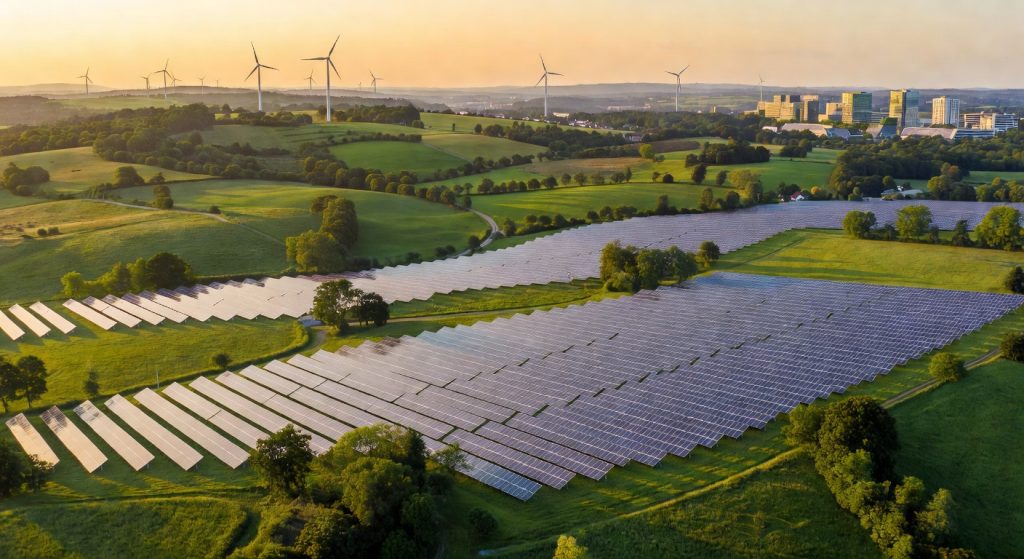
The global energy transition has never attracted more money. According to BloombergNEF, investment in clean energy reached a record $2.3 trillion in 2025, up 8% from the previous year. Renewables, battery storage, nuclear, green hydrogen, electric vehicles, and grid infrastructure all drew unprecedented funding — a clear signal that the business case for cleantech is stronger than ever, even as political headwinds in key markets threaten to slow momentum.
For European citizens, professionals, and policymakers watching this landscape, the picture is both encouraging and cautionary: green innovation is accelerating at a remarkable pace, but the gap between technological progress and coherent policy support is widening in ways that could reshape the global competitive order.
Breakthrough Technologies Redefining the Energy Transition
Behind the headline investment figures lies a wave of concrete technological advances that are quietly transforming what the energy transition can look like in practice.
Researchers have developed safer zinc-ion batteries capable of 900 charge cycles, offering a compelling alternative to lithium-ion systems for stationary storage and potentially for electric mobility applications. Unlike lithium, zinc is abundant, low-cost, and far less prone to thermal runaway — making it attractive for deployment in smart cities and community energy storage projects across Europe.
On the hydrogen front, redesigned fuel cells using low-cost materials are advancing the case for hydrogen-powered aviation and heavy transport — two of the hardest sectors to decarbonise. Meanwhile, a particularly striking green innovation has emerged from laboratory research: a solar reactor that converts plastic waste into clean hydrogen using old battery acid as a catalyst. This waste-to-energy approach embodies the circular economy principles that European industrial policy has long championed, potentially turning two pollution problems — plastic waste and spent batteries — into a clean fuel solution.
Fusion energy, long dismissed as perpetually decades away, is also receiving renewed institutional backing. The US Department of Energy has committed $135 million in new fusion funding, aiming to accelerate commercialisation timelines. While fusion remains a longer-term prospect, its potential to deliver virtually limitless, carbon-free baseload power makes it a strategic priority for energy security on both sides of the Atlantic.
The Policy Fault Line: US Reversals vs. Global Investment Boom
The contrast between technological momentum and political reality is nowhere sharper than in the United States. While global investment in the energy transition is booming, the Trump administration has moved aggressively to dismantle key pillars of US clean energy infrastructure:
- A $4.9 billion transmission loan has been cancelled, hampering the grid expansion needed to carry renewable power to consumers.
- Clean energy funds have been raided, threatening the pipeline of solar and wind projects and leading to business layoffs across the sector.
- Federal permitting delays continue to stall projects that have already secured private financing.
The irony is acute: US grid battery manufacturing is actually surging, driven by private sector confidence — yet policy instability is undermining the transmission and generation infrastructure that would make those batteries useful at scale. Ordinary citizens stand to lose access to cheaper, cleaner electricity as a result.
From a European perspective, this creates both a risk and an opportunity. The risk is that US policy volatility introduces uncertainty into global supply chains for cleantech components. The opportunity is that Europe — with its Green Deal industrial framework, REPowerEU targets, and Net-Zero Industry Act — can position itself as the world’s most reliable destination for long-term clean energy investment.
What This Means for Europe’s Green Transition
Europe is not insulated from global policy turbulence, but it enters this moment with structural advantages. The continent’s commitment to grid modernisation, its growing ecosystem of cleantech startups, and its regulatory clarity on carbon pricing give European industry a foundation that investors increasingly value.
The technologies emerging now — advanced batteries, green hydrogen, waste-to-fuel systems, and eventually fusion — align directly with Europe’s industrial decarbonisation needs. Heavy industry, aviation, and long-haul transport are all sectors where European companies are actively seeking scalable solutions. The innovations described above are not distant prospects; several are approaching commercial viability within this decade.
For smart cities and urban planners, the convergence of cheaper storage, cleaner hydrogen, and more resilient grids opens new pathways for local energy autonomy — reducing dependence on volatile fossil fuel markets and strengthening community resilience.
Key takeaway: The energy transition is no longer a question of whether — it is a question of who leads and who falls behind. With $2.3 trillion flowing into cleantech globally and breakthrough innovations arriving faster than policy can absorb them, Europe has a narrow but real window to consolidate its role at the centre of the green economy. The technologies are ready. The investment is there. What remains is the political will to match them.