Solar Breakthroughs, Vertical Farms, and AI Grids: Green Tech’s Big Leap in 2025–2026
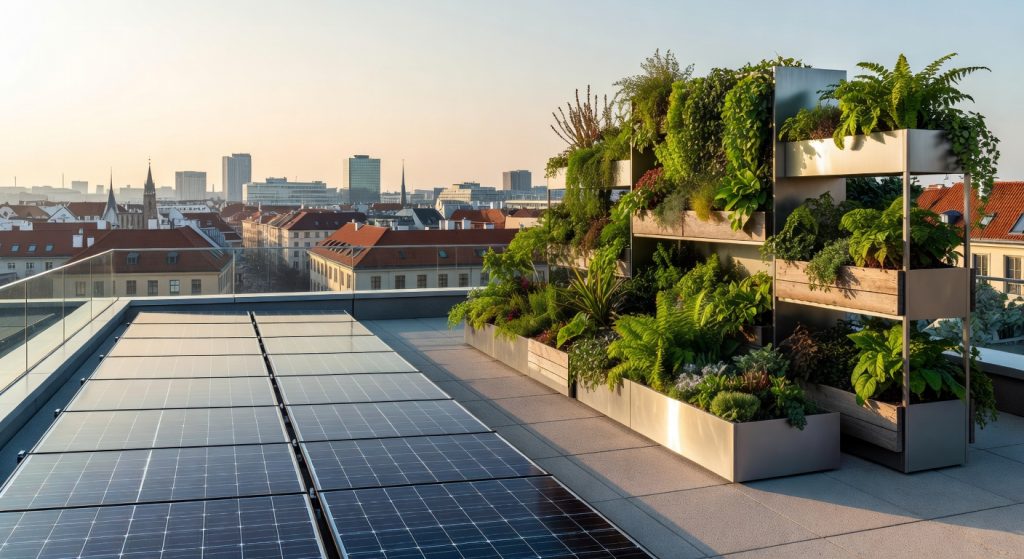
The green technology sector is experiencing one of its most dynamic periods in recent memory. Across solar energy, urban agriculture, and smart grid management, a wave of innovations is moving from laboratory promise to real-world deployment — with significant implications for citizens, businesses, and policymakers navigating the energy transition. Here is what the latest developments tell us about where cleantech is heading.
Perovskite Solar: From Lab Curiosity to Commercial Reality
For years, perovskite solar cells have tantalized researchers with their extraordinary efficiency potential. Now, two major milestones suggest the technology is finally crossing the threshold into commercial viability.
In the United States, Tandem PV has secured a $4 million grant from the California Energy Commission to accelerate the commercialization of ultra-efficient perovskite-silicon tandem solar panels. These hybrid cells stack two light-absorbing layers — one perovskite, one silicon — to capture a broader spectrum of sunlight, pushing theoretical efficiency well beyond the limits of conventional silicon panels alone.
Meanwhile, in the UK, Oxford PV’s CEO has publicly addressed the critical challenge of translating laboratory perovskite performance into consistent real-world results — a hurdle that has historically slowed cleantech scalability. Oxford PV, one of Europe’s leading perovskite pioneers, is positioning its technology for grid-scale integration, a development that could significantly accelerate decarbonization timelines across the continent.
For Europe, where energy independence has become a strategic priority following the disruptions of recent years, next-generation solar is not merely a climate story — it is an industrial and geopolitical one. Higher-efficiency panels mean more energy output per square metre, reducing land use and lowering the cost of the energy transition for both businesses and households.
Vertical Farming Grows Up: From Salads to Living Rooms
Urban green innovation is taking a surprising new direction. Fischer Farms, the UK-based vertical farming company, launched a range of vertically farmed houseplants on 2 April 2026, following the commercial success of its indoor-grown salad products. The move signals a broader ambition: bringing controlled-environment agriculture into everyday domestic life, not just supermarket supply chains.
Vertical farming — growing crops in stacked, climate-controlled indoor environments — uses up to 95% less water than conventional agriculture and eliminates the need for pesticides, while producing food and plants year-round regardless of season or weather. As smart cities increasingly integrate green infrastructure into urban planning, vertically farmed products offer a scalable, low-footprint solution for greening both homes and public spaces.
The expansion into houseplants is particularly noteworthy. It democratises access to sustainably grown greenery, connecting citizens directly to green innovation in a tangible, everyday way — and opens a new commercial frontier for urban agriculture businesses across Europe.
AI and Green Finance: Building the Infrastructure for Net Zero
Technology alone cannot drive the energy transition — it requires smart systems and robust financing. Two recent developments highlight progress on both fronts.
In the UK, Centrica has identified AI-driven demand-side flexibility as a critical tool for managing grid pressures as renewable energy penetration grows. By using artificial intelligence to shift electricity consumption — in homes, factories, and electric mobility infrastructure — to periods of low demand or high renewable generation, the grid can absorb more clean energy without costly upgrades. For citizens, this translates into lower energy bills; for businesses, it means greater resilience and reduced exposure to price volatility.
On the financing side, Morocco’s SAHAM BANK secured €55 million from the European Bank for Reconstruction and Development (EBRD) in July 2025 to expand green finance across the country. The funding will support energy transition projects and sustainable business lending in a region that sits at the intersection of European climate ambition and African development needs — a reminder that the green economy is a global project requiring cross-border capital flows.
What This Means for Europe’s Green Future
Taken together, these developments paint a coherent picture of green innovation maturing across multiple fronts simultaneously:
- Solar technology is approaching a step-change in efficiency and commercial readiness, with European companies at the forefront.
- Urban agriculture is expanding its reach, making sustainable production accessible to ordinary households.
- AI and smart financing are providing the systemic backbone that large-scale decarbonisation requires.
For decision-makers, the message is clear: the conditions for accelerating the green transition are aligning. The challenge now is ensuring that policy frameworks, investment pipelines, and public engagement keep pace with the technology itself.
Key takeaway: Green technology is no longer a future promise — it is a present reality scaling rapidly across energy, agriculture, and smart city infrastructure. Europe has both the innovation ecosystem and the policy ambition to lead this transformation, but seizing the moment will require coordinated action from governments, businesses, and citizens alike.