Solar, Wind, and Storage Set to Dominate New Energy Capacity in 2026 — What It Means for Europe and Beyond
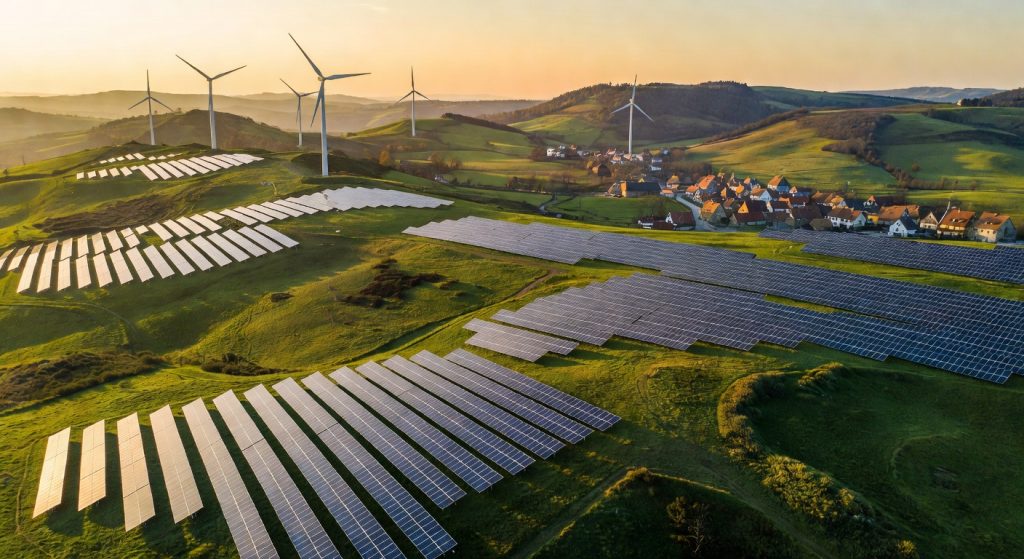
The numbers are in, and they tell a striking story. According to the US Energy Information Administration (EIA), solar, wind, and battery storage are projected to account for over 55 GW of new capacity additions in the United States alone in 2026 — compared to under 1 GW from fossil fuel sources. Meanwhile, renewables already supplied 25.1% of US electricity in January 2026, up 11% year-on-year, representing 36.6% of total installed capacity. These are not incremental gains. They signal a structural shift in how the world generates and manages energy.
And the United States is not alone. From Germany’s wind tenders to Spain’s solar boom and the UK’s geothermal experiments, the global transition to clean energy is accelerating — even as political headwinds attempt to slow it down.
Europe Accelerates: Wind, Solar, and Geothermal Lead the Way
Europe continues to push forward with bold, policy-driven momentum. Germany has announced tenders for 12 GW of new onshore wind capacity under its Climate Action Program 2026 — the equivalent of approximately 2,000 turbines and the output of 15 to 20 gas-fired power plants. This is a direct response to the urgency of reducing coal and gas dependency, while reinforcing the EU’s broader energy transition goals.
Spain, meanwhile, has doubled its combined solar and wind capacity in just six years, a feat that has measurably shielded its economy from the price volatility that has plagued fossil fuel markets since 2021. Greater energy independence translates directly into more stable electricity prices for households and businesses — a lesson the rest of Europe is taking seriously.
The United Kingdom is charting its own innovative course. The country has launched its first deep geothermal plant, capable of delivering round-the-clock power to around 10,000 homes. Alongside this, the UK is piloting shallow geothermal energy extraction from disused coal mines — repurposing industrial heritage for clean energy generation. These projects highlight how energy efficiency and resource management can go hand in hand with decarbonisation.
Corporate Investment and Grid Resilience: The Business Case Strengthens
Beyond government policy, the private sector is increasingly driving the renewable energy surge. Nike and Mitsui have signed a solar power purchase agreement (PPA) covering 70% of Nike’s electricity needs in Japan — a clear signal that multinational corporations are embedding clean energy into their core operations, not just their sustainability reports.
In Portugal, energy company EDP reported a 44% rise in profits, attributed directly to improved efficiency across its renewables portfolio. In Texas, 6.5 GW of utility-scale solar was added in 2025 alone, making it the leading US state for solar deployment. Rising demand from data centres — energy-hungry by nature — is paradoxically accelerating investment in clean power infrastructure, as companies seek both cost stability and green credentials.
Even in the face of US policy challenges — including tightened Inflation Reduction Act (IRA) tax credit deadlines under the Trump administration — renewables continue to fill 95% of grid interconnection queues. States are pushing interconnection reforms independently, and capital is flowing toward clean energy at scale.
Implications for Citizens, Businesses, and Policymakers
What does this mean in practice? For citizens, the expansion of solar, wind, and storage infrastructure means greater energy security, lower long-term electricity costs, and reduced exposure to geopolitical shocks tied to fossil fuel markets. For businesses, the message is clear: investing in renewable energy — whether through PPAs, on-site solar, or energy efficiency upgrades — is no longer just an ethical choice but a financial one.
For policymakers, particularly in Europe, the data reinforces the case for sustained public investment and regulatory clarity. Germany’s 12 GW wind programme and Spain’s capacity doubling did not happen by accident — they were the result of consistent, long-term policy frameworks that gave investors the confidence to act.
- Solar and wind are now the cheapest forms of new electricity generation in most markets.
- Battery storage is closing the gap on intermittency concerns, enabling greater grid resilience.
- Geothermal energy offers promising baseload potential, particularly for northern Europe.
- Corporate PPAs are becoming a mainstream tool for energy cost management and decarbonisation.
Key takeaway: The 2026 energy outlook confirms that the renewable transition is no longer a future aspiration — it is the present reality. Despite policy turbulence in the US and ongoing fossil fuel lobbying globally, solar, wind, storage, and emerging technologies like geothermal are reshaping the energy landscape at speed. For Europe, which has both the policy ambition and the industrial capacity to lead, the window to consolidate this advantage is wide open.