Carbon Markets, Circular Economy, and ESG Reform: What’s Shaping Sustainability in 2026
The first quarter of 2026 has delivered a wave of significant developments across sustainability, ESG regulation, and climate finance — reshaping how governments, businesses, and investors approach decarbonization. From a landmark carbon market launch in India to a major overhaul of European corporate reporting rules, the signals are clear: the architecture of green business is being rebuilt at speed, and the stakes have never been higher.
India’s Carbon Market Portal: A New Chapter for Global Climate Finance
At the Prakriti 2026 conference and the Bharat Electricity Summit, India unveiled the Indian Carbon Market Portal — a centralized platform designed to streamline carbon credit trading, accelerate industrial emissions reductions, and attract climate finance at scale. The move positions India as a serious player in global carbon markets, joining a growing number of nations building the financial infrastructure needed to meet Paris Agreement targets.
For European businesses and policymakers, this development carries direct relevance. As the EU’s own Carbon Border Adjustment Mechanism (CBAM) comes into force, the emergence of credible, transparent carbon pricing systems in major economies like India could ease trade tensions and create new opportunities for sustainable finance collaboration. A well-functioning Indian carbon market also strengthens the case for Article 6 of the Paris Agreement — the framework governing international carbon trading — which has long struggled to gain traction. Carbon markets are increasingly recognized not just as environmental tools, but as critical infrastructure linking policy ambition, corporate responsibility, and investment flows.
Europe’s Green Economy in Motion: Plastics Recycling and Solar for Industry
Closer to home, two developments illustrate the practical momentum of Europe’s sustainability transition. TotalEnergies inaugurated France’s first advanced plastics recycling plant — a milestone for the circular economy that signals growing industrial commitment to material reuse and waste reduction. Advanced chemical recycling, which breaks plastics down to their molecular components for reuse, has long been heralded as essential to closing the loop on plastic waste. Bringing this technology to commercial scale in France marks a meaningful step beyond pilot projects.
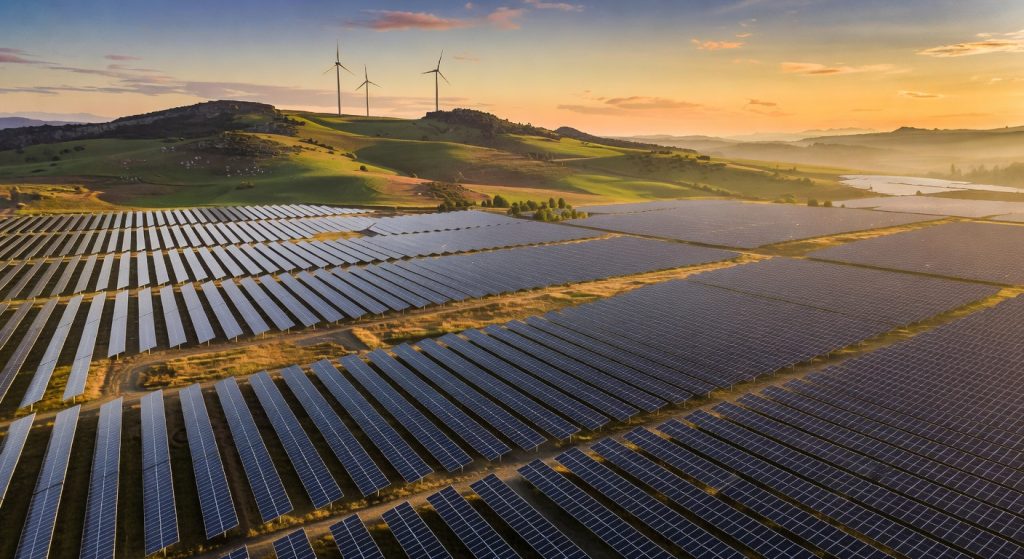
Meanwhile, in Spain, energy company Zelestra brought a 162 MW solar cluster online specifically to power decarbonization in the pharmaceutical sector. The project is a textbook example of how renewable energy deployment is increasingly tailored to hard-to-abate industries — and how corporate net-zero commitments are driving real infrastructure investment. Together, these projects reflect the trending convergence of circular economy innovation and industrial decarbonization that is defining Europe’s green business landscape in 2026.
ESG Regulation: Europe Simplifies, California Pushes Forward
On the regulatory front, the picture is more nuanced. The EU adopted Directive 2026/470 on 24 February 2026, introducing significant changes to the Corporate Sustainability Reporting Directive (CSRD) and the Corporate Sustainability Due Diligence Directive (CSDDD). The reform raises reporting thresholds, extends compliance timelines, and simplifies requirements — offering relief to thousands of mid-sized businesses that had been struggling with the scope and cost of compliance. Member States must now transpose these changes into national law.
The move reflects a broader political recalibration in Brussels: maintaining ESG ambition while reducing administrative burden on companies, particularly SMEs. Critics warn that simplification risks diluting the quality and comparability of sustainability data. Supporters argue it makes the framework more durable and enforceable in practice.
Across the Atlantic, California is moving in a different direction. The California Air Resources Board (CARB) is advancing SB 253 and SB 261 — landmark climate disclosure laws — with a Scope 1 and 2 emissions reporting deadline of 10 August 2026, despite an ongoing injunction against SB 261. Large companies operating in the US must prepare flexible compliance strategies that account for ongoing legal uncertainty.
Implications for Businesses and Decision-Makers
What do these developments mean in practice? Several priorities emerge for companies navigating the sustainability landscape:
- Monitor carbon market developments globally — India’s platform and evolving Article 6 rules will affect supply chains, offsets, and cross-border climate finance strategies.
- Reassess CSRD and CSDDD compliance timelines in light of EU Directive 2026/470, but avoid treating simplification as a signal to reduce ESG ambition.
- Invest in circular economy and renewable energy infrastructure — both are increasingly central to credible corporate decarbonization strategies.
- Build adaptable reporting frameworks that can respond to diverging regulatory requirements across the EU, UK, and US.
Key takeaway: 2026 is shaping up as a year of structural consolidation in sustainability and ESG — not retreat. Whether through carbon markets in Delhi, solar clusters in Castile, or recycling plants in Normandy, the transition is accelerating. The rules are being refined, not abandoned. Businesses that treat this moment as an opportunity to build genuine resilience — rather than a compliance exercise — will be best positioned for what comes next.