Solar and Storage Break Records in 2025: What the Global Renewables Surge Means for Europe
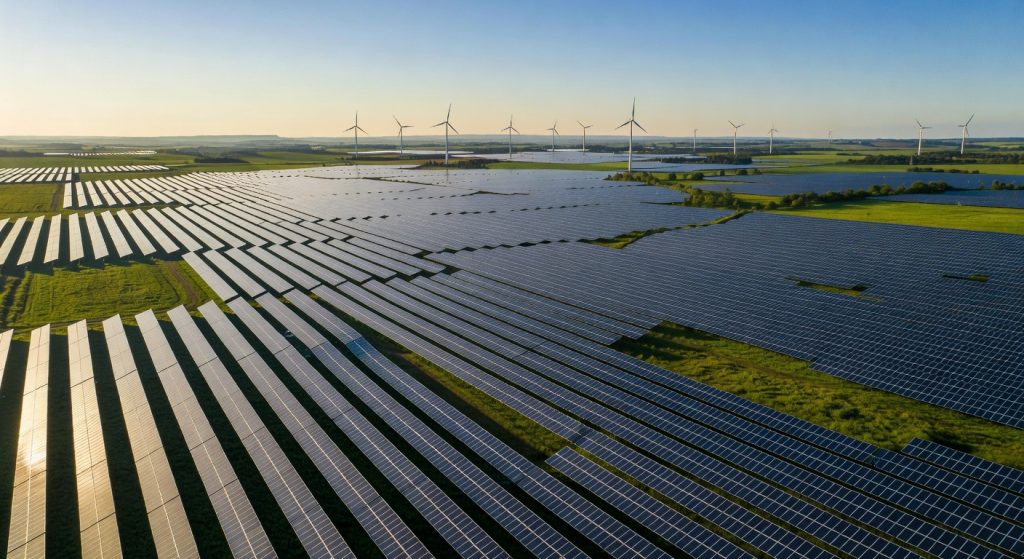
The world’s energy landscape is shifting faster than most forecasts predicted. From the plains of Texas to the waters off the Danish coast, renewable energy infrastructure is being built at a pace that would have seemed extraordinary just a decade ago. The latest data from the US Energy Information Administration (EIA) and a string of international project milestones paint a picture of an industry accelerating — even as policy uncertainty lingers on both sides of the Atlantic.
A Record-Breaking Year for Solar and Battery Storage
The EIA’s most recent monthly review projects that the United States will add a staggering 43.4 gigawatts (GW) of utility-scale solar photovoltaic capacity in 2026 — a 60% year-on-year increase that would make solar responsible for 51% of all new electricity generation capacity. Combined with 24.3GW of battery energy storage systems (BESS) and 11.8GW of new wind, total new US generation capacity is forecast to reach 86GW in a single year.
These are not abstract numbers. Projects like the 837MW Tehuacana Creek 1 solar farm in Texas, co-located with 418MW of battery storage, illustrate how the industry is evolving: large-scale solar is increasingly paired with storage to address grid reliability concerns, smoothing out the intermittency that has historically been cited as a barrier to deeper renewable penetration. Texas alone is driving a disproportionate share of new builds, cementing its role as the unlikely capital of America’s clean energy transition.
For European observers, this trajectory is both inspiring and instructive. The EU has set a target of 600GW of solar capacity by 2030, and while progress is strong, the scale and speed of US deployment — even amid political headwinds — demonstrates what is achievable when permitting, grid investment, and private capital align.
Europe’s Offshore Wind Momentum and the Energy Security Argument
Europe is not standing still. The Thor Offshore Wind Farm off the Danish coast — a 1.1GW project — has connected its first turbine to the grid and is progressing on schedule. When fully operational, Thor will power the equivalent of roughly one million Danish households, reinforcing Denmark’s position as a global leader in offshore wind energy and contributing to the EU’s broader clean power ambitions.
The timing matters. The UN’s climate chief recently underscored a point that European policymakers have been grappling with since 2022: war-driven energy price spikes expose the vulnerability of fossil fuel dependence. Renewables, by contrast, offer price stability and domestic supply security. This is not merely an environmental argument — it is a strategic one. Investing in solar, wind, and energy storage is increasingly framed as a matter of national and regional resilience, reducing exposure to geopolitical disruptions in global commodity markets.
Efficient resource management — including smarter grid infrastructure and improved energy efficiency across industry and buildings — remains the essential complement to new generation capacity. Building gigawatts of clean power is only half the equation; using that power wisely is the other.
Emerging Markets Enter the Picture
The renewables surge is no longer confined to wealthy economies. India’s GREW Solar has secured a $223 million contract to supply 1,464.5MW of high-efficiency PV modules to NTPC REL, while simultaneously scaling domestic manufacturing capacity to 11GW. This dual focus — deploying clean energy and building industrial capability — is a model other emerging economies are watching closely.
Meanwhile, US firm Energea has made its first move into Africa with a $462,000 investment in a 281.82kW solar-storage microgrid in South Africa, paired with 700kWh of battery storage. Small in absolute terms, but symbolically significant: distributed solar and storage are increasingly viable tools for expanding energy access in regions where grid infrastructure remains limited. Water pumping, cold storage for food, and healthcare facilities are among the services that reliable microgrids can unlock — connecting energy access to water and resource security in tangible ways.
What This Means for European Citizens and Decision-Makers
The global momentum in renewable energy carries clear implications for Europe:
- Supply chains are tightening: Demand for solar panels, wind components, and battery storage is surging globally. European manufacturers and policymakers must act decisively to secure domestic production capacity and avoid dependency on a single supplier.
- Grid investment cannot wait: New generation without upgraded grids creates bottlenecks. The EU’s electricity market reform and TEN-E infrastructure guidelines need faster implementation.
- The energy security case is now mainstream: Framing renewables as a geopolitical necessity — not just a climate obligation — broadens political support and accelerates decision-making.
Key takeaway: The global renewables boom of 2025–2026 is not a future scenario — it is happening now, in real projects, with real capital. Europe has the targets, the technology, and the motivation. The challenge is matching the urgency of the moment with the speed of execution.